

How to Build a Crypto Trading Plan
(Step by Step)


The single behavioural change that improves new traders’ results the most is also the most boring: writing down a plan before the trade, and following it during. This is not glamorous, and it does not produce screenshots that get attention on social media. But the gap between traders with a written plan and traders without one is large enough to be visible in any dataset of retail returns, and it widens with time.

A useful trading plan has six sections.

One: objectives and constraints

What are you trying to accomplish with this capital? “Make money” is not specific enough. Practical objectives look like: “Grow this portfolio at an average annualized rate higher than my benchmark over a three-year horizon, accepting up to 50% interim drawdowns.” Constraints look like: “I will not deploy more than 30% of total liquid net worth into crypto. I will not use leverage. I will not invest funds I might need within twelve months.” These constraints define the boundary inside which the rest of the plan operates.

Two: portfolio construction

What are you trying to accomplish with this capital? “Make money” is not specific enough. Practical objectives look like: “Grow this portfolio at an average annualized rate higher than my benchmark over a three-year horizon, accepting up to 50% interim drawdowns.” Constraints look like: “I will not deploy more than 30% of total liquid net worth into crypto. I will not use leverage. I will not invest funds I might need within twelve months.” These constraints define the boundary inside which the rest of the plan operates.

Two: portfolio construction

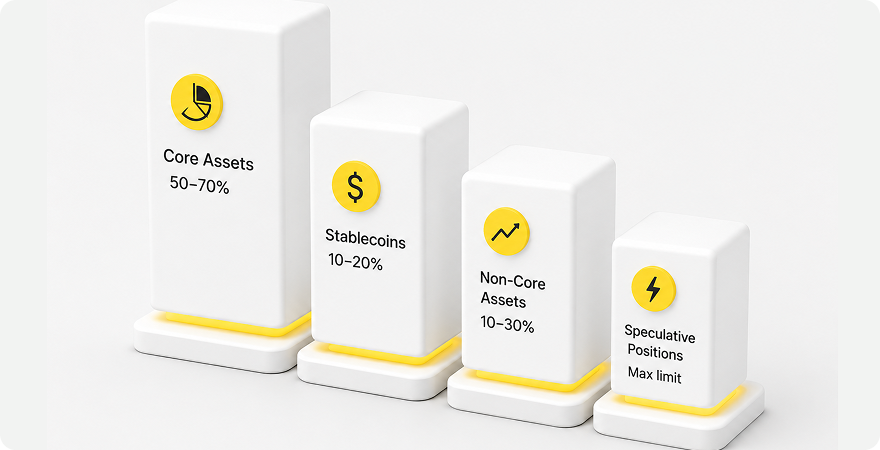
What’s the target allocation across categories? A reasonable starting structure for a beginner is something like: 50–70% in core assets (BTC and ETH), 10–20% in stablecoins as dry powder and yield generation, 10–30% in higher-conviction non-core assets, and a hard ceiling on speculative positions. The exact numbers matter less than the discipline of having them written down. The plan also specifies rebalancing rules: when do you rebalance back to target, and what triggers a structural change to the targets themselves.
Three: entry criteria

What has to be true for you to open a new position? This includes both the trade thesis and the market context. A thesis-only entry — “I think this protocol is undervalued” — is incomplete without context: at what price level, with what position size, with what time horizon. The criteria don’t have to be quantitative, but they have to be specific enough that you can tell after the fact whether they were met.

Four: exit criteria

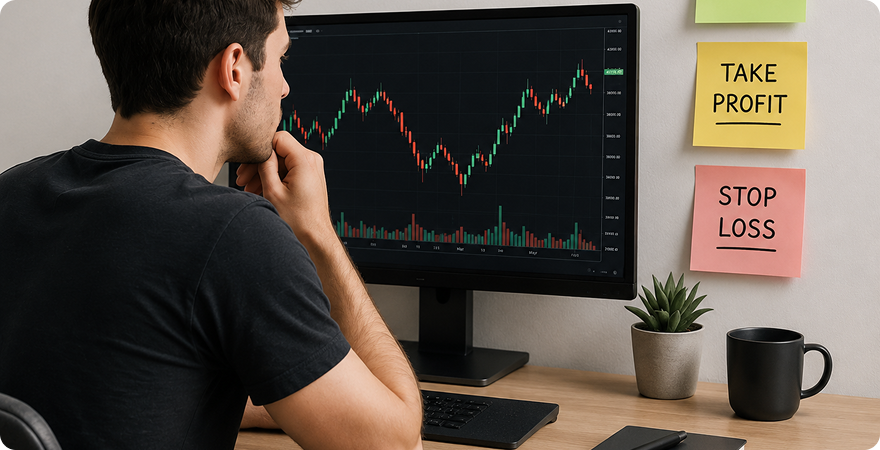
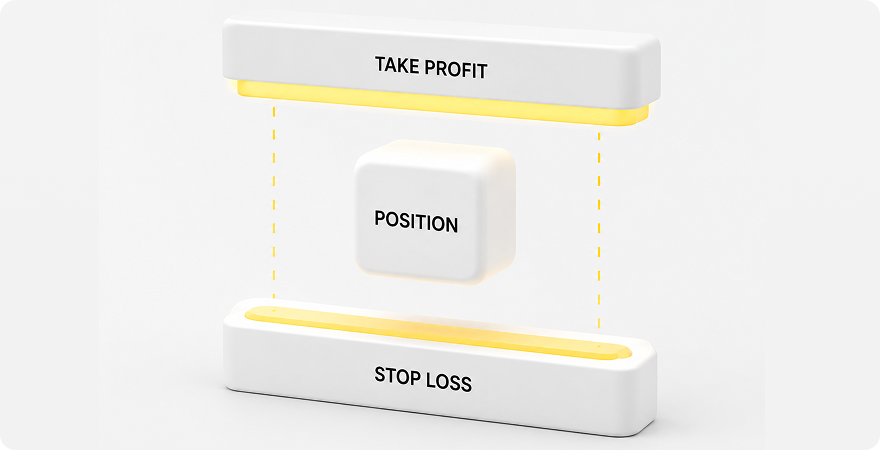
This is the section most traders skip and most regret skipping. Every position needs two pre-defined exits: the price at which the thesis has played out (take profit) and the price at which the thesis has been disproven (stop loss). Both numbers should be set before the position is opened and adjusted only based on new information, not based on emotional response to price movement. A useful rule: if you would not enter the position at the current price, you should be exiting it.
Five: risk management

Maximum position size per trade, maximum total exposure to a single sector or narrative, maximum acceptable drawdown before defensive action (reducing positions, moving to stablecoins, pausing new entries). The risk management section should make explicit what conditions would cause you to step back from the market entirely. New traders almost never set this in advance, which means by the time the conditions are met, they’ve already passed them.

Six: review cadence

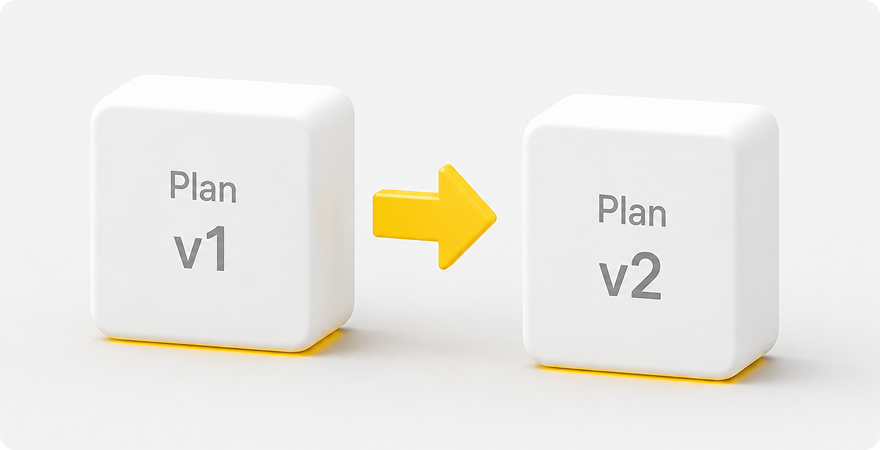
When do you review the plan itself? Quarterly is reasonable for most non-professional traders. The review is not for tweaking based on recent performance — that’s curve-fitting — but for evaluating whether the plan still matches your objectives, your constraints, and your understanding of the market. A plan you wrote in a bull market and never revised is not the right plan for a bear market.
What a plan does not contain

Specific predictions about asset prices. Promises about returns. A long list of contingencies for every possible market state. The plan should be short enough that you can re-read it in five minutes. If it’s longer than two pages, it’s a research document, not a plan.

The traders who outperform are not the ones with the best analysis. They’re the ones who follow a mediocre plan consistently while everyone around them follows brilliant analyses inconsistently. 
The plan is the edge.



The 7 Most Common Mistakes New
Crypto Traders Make


The mistakes that destroy new crypto traders are not exotic. They’re predictable, they repeat across every market cycle, and they account for the overwhelming majority of avoidable losses. Recognizing them in advance is most of the protection.

One: position sizing that doesn’t survive a normal drawdown

New traders consistently size positions as if a 20% drawdown is unlikely. In crypto, a 20% drawdown is a routine occurrence on a multi-month horizon, and a 50% drawdown happens on roughly every major asset every few years. A position that’s comfortable at current prices but would be intolerable at half those prices is a position that’s too large. The right sizing question is not “what’s the expected return?” — it’s “would I be willing to hold this through a 50% drawdown without panicking?”

Two: no exit plan before entering

A trade is a complete idea only when the exit is defined. Both exits, actually: the price at which you take profit and the price at which you accept the thesis was wrong. New traders almost always have a clear entry thesis and almost never have a clear exit. The result is that decisions get made in the middle of volatility, which is the worst possible time to make them. The exit plan must be written down before the position is opened. Otherwise it doesn’t exist.

Three: using leverage early

Leverage in crypto is genuinely lethal to inexperienced traders. The combination of high underlying volatility and high leverage produces liquidations on relatively small adverse moves, and once you’ve been liquidated you no longer have a position to recover with when the market reverses. New traders are repeatedly drawn to leverage by the visible returns it produces in upside scenarios, while the much more frequent downside scenarios — liquidation, forced exit, account drained — are less visible because they don’t get screenshotted. Build your reflexes on spot. Leverage can wait.

Four: chasing pumps

A 30% rally over two days feels like an opportunity. It’s usually a distribution event. Buying after a sharp rally typically means buying from someone who’s been holding for months and is now selling into retail demand. New traders consistently buy late and sell early because the emotional signal — “everyone is excited about this” — is exactly inverted from the correct timing signal.

Five: confusing conviction with concentration

New traders who develop a strong thesis on a single asset often allocate disproportionately to it. Even when the thesis is correct, this is dangerous: a position large enough to be life-changing on the upside is large enough to be life-changing on the downside, and crypto regularly produces scenarios where a high-conviction position goes to zero (FTT, LUNA, dozens of others). A reasonable maximum on a single non-major asset is somewhere between 5% and 15% of the portfolio. Higher than that, the position is no longer a trade — it’s a bet on whether you’re right about the future.

Six: leaving large balances on exchanges

“Not your keys, not your coins” is a cliché because it’s true. Exchanges fail, freeze withdrawals, and occasionally lose customer funds. The lesson of the 2022 cycle was not that all exchanges are bad — it was that exchange custody is operationally convenient but structurally inferior to self-custody for any balance large enough to matter. The right pattern: keep working capital on the exchange, move long-term holdings to a hardware wallet you control.

Seven: trading on social media signals

Most influential crypto accounts are either openly long the assets they promote, paid to promote them, or both. The disclosure norms in crypto are weaker than in any other financial market, and the incentive structure of social media rewards confidence over accuracy. The traders who consistently make money are not the ones with the most followers. The right framework is to consume social media for narrative awareness — what’s being discussed — and to develop your own views on the underlying data rather than outsourcing them to anyone with a microphone.

None of these mistakes are about asset selection. All of them are about behaviour. Which means all of them are inside your control.


BTC vs ETH vs USDT: Which Should
You Start With?


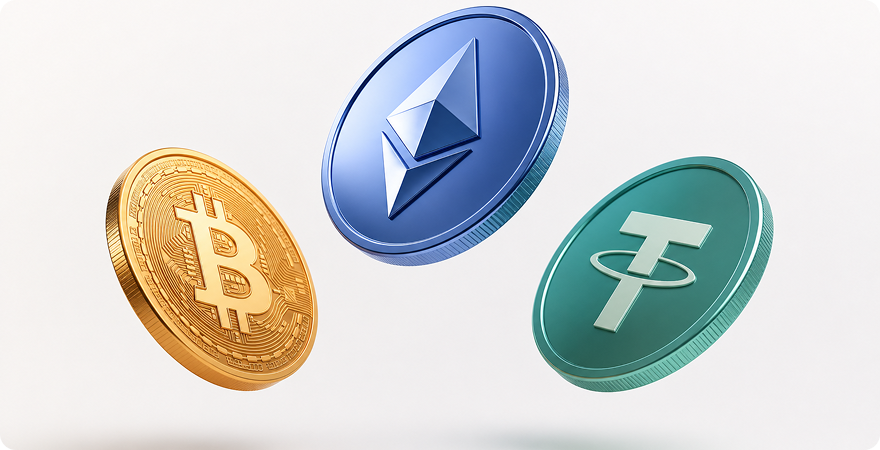
The three largest crypto assets by market capitalisation — Bitcoin, Ethereum, and Tether — are often grouped together in beginner conversations as if they’re interchangeable. They’re not. Each was designed to do a fundamentally different thing, and the right starting point depends entirely on what you’re trying to accomplish.

Bitcoin (BTC): digital scarcity

Bitcoin was designed as digital money with a fixed supply cap of 21 million coins, no central issuer, and no possibility of monetary debasement. The thesis is straightforward: a scarce, censorship-resistant, globally accessible asset has value as a store of wealth, particularly in an environment of expanding fiat money supply. Bitcoin’s track record is the longest in the asset class — 16 years and counting. It’s the most liquid, the most institutionally adopted, and the most volatility-tested. It does one thing — store value — and it does that one thing better than any alternative.

What Bitcoin doesn’t do: smart contracts, decentralised applications, programmable money. The base layer is intentionally simple and deliberately slow to change. If you want functionality beyond holding and transferring value, Bitcoin is not the asset.

Ethereum (ETH): programmable money

Ethereum was designed as a general-purpose computing platform that happens to be denominated in cryptocurrency. The ETH token is partly a store of value, partly a payment for using the network (the gas that powers transactions), and partly a productive asset that can be staked to earn yield. The thesis is that a global, decentralised computer with no single point of failure has economic value, and that value accrues to ETH because ETH is the asset that powers it.

Ethereum’s risk profile is higher than Bitcoin’s. The protocol is more complex, the upgrade cadence is faster, and competing smart-contract platforms — Solana, Avalanche, others — are credible. The upside profile is also higher because the addressable market for “programmable money” is larger than the addressable market for “digital gold.”

Tether (USDT): dollar exposure on-chain

USDT is not an investment in the same sense as BTC or ETH. It’s a stablecoin pegged 1:1 to the US dollar, designed to hold its value rather than appreciate. The thesis for owning USDT is access, not return: you hold USDT to participate in crypto markets without taking price risk, to send dollar-equivalent value across borders without going through the banking system, or to earn yield through lending and DeFi protocols.

USDT’s risk is not market volatility. It’s issuer risk. Tether (the company) is supposed to hold dollar-denominated reserves backing every USDT in circulation. The composition of those reserves has been a recurring topic of discussion across the industry, and the regulatory framework is still maturing. USDC, issued by Circle, is structurally similar but operates under tighter US regulatory oversight; the trade-off is slightly less ubiquitous availability across smaller venues.

Which one should you start with?

Start with BTC if your primary thesis is wealth preservation, you have a multi-year time horizon, and you want the lowest-complexity, longest-track-record exposure in the asset class. This describes most beginners accurately, even if it doesn’t feel exciting.

Start with ETH if you want exposure to the broader trajectory of crypto beyond store-of-value, you’re comfortable with higher volatility and more protocol risk, and you intend to engage actively with the on-chain ecosystem (staking, DeFi, NFTs) rather than just holding.

Start with USDT or USDC if you don’t yet have a directional view, you want to onboard capital into the crypto ecosystem without taking immediate price risk, or you’re using crypto rails for payment and transfer purposes rather than as an investment.

The most common mistake beginners make is choosing based on which asset has the most narrative momentum at the moment of decision. The right framework is choosing based on what you’re actually trying to do.


The Essential Crypto Glossary: 40 Terms Every Trader Should Know


Most crypto glossaries are either too shallow to be useful or too technical to be readable. This one targets the middle: forty terms that come up regularly in crypto trading and that, once understood, unlock most of the rest of the vocabulary.

Market structure terms

Liquidity. The depth of buy and sell orders on an exchange. High liquidity means large orders can be filled without significantly moving the price.

Spread. The difference between the highest bid and the lowest ask. Wider spreads mean higher round-trip trading costs.

Slippage. The difference between the expected price of a trade and the actual fill price, caused by trading through multiple price levels in the order book.

Order book. The list of open buy and sell orders on an exchange, ranked by price.

Market order. An order to buy or sell immediately at the best available price.

Limit order. An order to buy or sell at a specified price or better.

Stop-loss order. A conditional order that becomes a market order when a specific price level is reached, used to limit losses.

OTC. Over-the-counter; trades negotiated directly between two parties rather than executed on a public order book.

Asset and protocol terms

Bitcoin (BTC). The first and largest cryptocurrency by market capitalisation, designed as a peer-to-peer electronic cash system.
 
Ethereum (ETH). The second-largest cryptocurrency, designed as a programmable blockchain that supports smart contracts.
 
Stablecoin. A cryptocurrency designed to maintain a fixed value, usually pegged to a fiat currency like the US dollar.

USDT, USDC. The two largest stablecoins by market capitalisation, both pegged to the US dollar.
 
Altcoin. Any cryptocurrency other than Bitcoin.
 
Token. A cryptocurrency that runs on top of another blockchain, as opposed to a coin that has its own native blockchain.
 
Smart contract. Self-executing code deployed on a blockchain, enabling programmable transactions.
 
Gas. The fee paid to network validators for processing transactions on a blockchain like Ethereum.

Custody and security terms

Wallet. Software or hardware that stores the private keys needed to access cryptocurrency.
 
Private key. The cryptographic key that authorises spending from a wallet. Whoever controls the private key controls the funds.
 
Seed phrase. A human-readable backup of a wallet’s private keys, typically twelve or twenty-four words.
 
Hot wallet. A wallet connected to the internet, convenient but more vulnerable to compromise.
 
Cold wallet. A wallet stored offline, typically on a hardware device, much less vulnerable to remote attack.
 
Self-custody. Holding cryptocurrency in a wallet whose private keys you control, as opposed to leaving funds on an exchange.
 
KYC. Know Your Customer; the identity verification process required by regulated exchanges.
 
AML. Anti-Money Laundering; the regulatory framework that governs financial institutions, including crypto exchanges.

Trading and derivatives terms

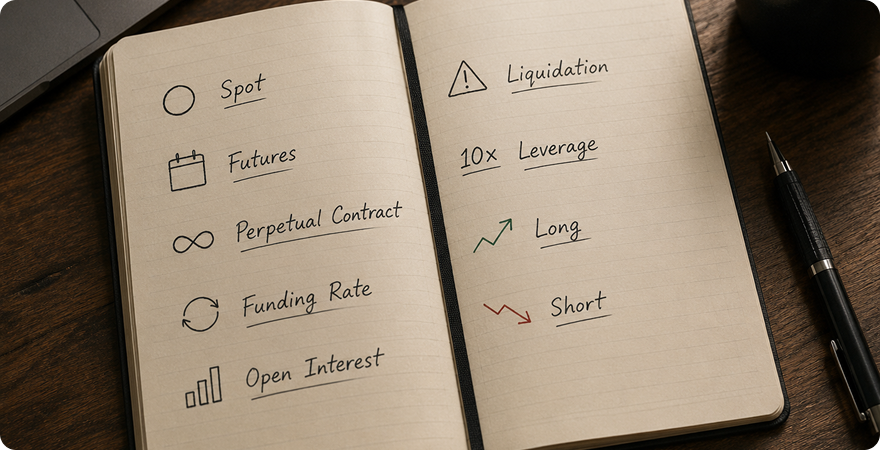
Spot. The market for immediate delivery of an asset, as opposed to derivatives.
 
Futures. A contract to buy or sell an asset at a specified future date and price.
 
Perpetual contract. A futures contract with no expiry date, used widely in crypto for leveraged trading.
 
Funding rate. The periodic payment between long and short holders of a perpetual contract, designed to keep its price close to spot.

Open interest. The total number of open derivative contracts on a particular asset.
 
Liquidation. The forced closure of a leveraged position when its margin falls below the maintenance requirement.
 
Leverage. Borrowed capital used to amplify exposure to an asset. Multiplies both gains and losses.
 
Long. A position that profits if the asset’s price rises.
 
Short. A position that profits if the asset’s price falls.

Market behaviour terms

Bull market. A sustained period of rising prices.
 
Bear market. A sustained period of falling prices.
 
Drawdown. The decline from a peak to a subsequent trough, typically expressed as a percentage.
 
Volatility. The magnitude of price fluctuations over a given period.
 
Halving. The Bitcoin protocol’s scheduled reduction of new coin issuance, occurring roughly every four years.
 
Whale. A holder with a position large enough to influence the market through their trading activity.
 
HODL. Long-term holding of an asset through volatility, originally a typo of “hold” that became a community term.
 
DYOR. “Do your own research”; the standard disclaimer attached to crypto commentary.
 
This vocabulary covers the substantive surface area of crypto trading conversation. Once these terms are familiar, the next tier — specific protocols, narratives, and technical concepts — becomes much easier to absorb.


How to Follow Crypto Markets Without Burning Out


Crypto markets never close. The implicit pressure on participants is that they should also never close — that every overnight move, every weekend pump, every Asian-session liquidation requires real-time attention. This is wrong, and the cost of believing it is twofold. Your sleep deteriorates and your trading gets worse.

The traders who outperform over multi-year horizons share one habit that almost nobody talks about: they pay attention to less, not more. A structured, time-limited information routine outperforms continuous attention by a wide margin, for reasons that are mechanical rather than mystical.

Why continuous attention degrades decisions

Three effects compound. Reaction fatigue: every alert, every notification, every price movement triggers a small cognitive response. The cumulative effect over weeks is exhaustion, which manifests as worse risk management. Recency bias: the most recent price action dominates your perception of the market state, which means a trader watching every five-minute candle will systematically over-weight short-term noise relative to medium-term trends. And action bias: the more you watch, the more you feel pressure to act. Most of the time, the correct action is none.

A sustainable routine that takes thirty minutes per week

Twenty minutes on Monday morning, ten minutes on Friday afternoon, and that’s the entire weekly time budget for most non-professional traders.

Monday morning, twenty minutes: read one weekly market summary from a source you trust (the Bankless newsletter, The Block’s weekend wrap-up, or similar). Check the BTC and ETH weekly charts on the daily timeframe. Glance at funding rates and open interest. Look at on-chain exchange flow trends for the past week. That’s it. The goal is to enter the week with a directional bias, not a thesis on every asset.

Friday afternoon, ten minutes: review the week’s performance against your bias. Note one thing that surprised you. Note one thing you got right. Adjust the bias for next week. Don’t trade in this window — review only.

What to remove

Push notifications from price-alert apps, except for specific levels you’ve pre-decided matter. Telegram and Discord channels that produce more than ten messages per day. Twitter accounts that post more than twenty times per day on crypto. YouTube channels whose primary business model is keeping you watching. Any source that uses the word “MASSIVE” or “INSANE” in headlines. The selection criteria is signal density per minute, not entertainment value.

What to keep

One or two newsletters with high signal density. One or two long-form analysts who post weekly rather than hourly. Direct access to on-chain data dashboards (Glassnode, CryptoQuant, DefiLlama) that you check on your schedule, not theirs. The exchange’s official communications for the platforms you use. Macro information sources — Bloomberg, Reuters, FT — for the broader context that increasingly drives crypto.

The longer-term framing

Markets reward patience and punish urgency. A trader who participates with thirty minutes of weekly attention and a sustainable routine will, over five years, almost certainly outperform a trader who participates with thirty hours of weekly attention and a deteriorating one. The former has a sustainable practice. The latter has a hobby that’s slowly consuming them.

The market will be here next week. So should you be.


Timing the Crypto Market: Why DCA Usually Beats Lump-Sum (And When It Doesn’t)


Dollar-cost averaging is the strategy nobody finds exciting and almost everyone should be using. The reason is not that DCA produces the highest possible return — it doesn’t — but that it produces near-optimal returns for the actual human behaviour of the people executing it. The strategy that you can stick to through a fifty percent drawdown is worth more than the strategy that mathematically dominates in a spreadsheet but breaks down in your head at the moment of stress.

What DCA actually does

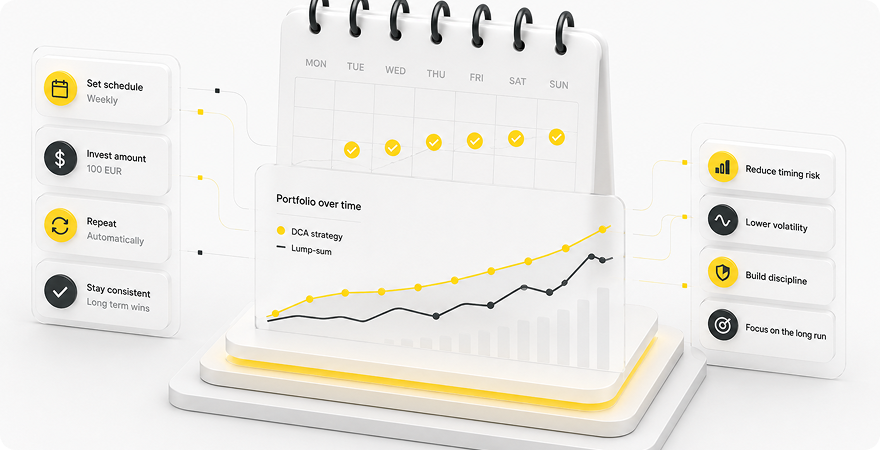
Dollar-cost averaging buys a fixed dollar amount of an asset on a fixed schedule, regardless of price. The mechanical effect is that you buy more units when the price is low and fewer units when the price is high, which produces an average entry price below the simple time average of the asset’s price over the period. The psychological effect, which matters more, is that the schedule replaces decision-making. You don’t have to time the entry, which means you can’t time it badly.

The case for DCA in crypto specifically

Crypto’s volatility makes timing both more tempting and more punishing. The asset class regularly produces 50% drawdowns and 200% rallies in compressed timeframes. The trader who tries to time entries is making high-stakes decisions in an environment specifically designed to defeat human pattern-matching. Studies of retail trading data — across both crypto and traditional markets — consistently show that retail traders underperform a simple buy-and-hold benchmark by a meaningful margin, and the underperformance is almost entirely attributable to bad timing rather than bad asset selection.

DCA removes timing as a source of error. Over a multi-year horizon in crypto, a weekly or monthly DCA into Bitcoin has historically outperformed approximately 90% of attempts at active timing by the same investor over the same period.

Where DCA underperforms

In persistently rising markets, lump-sum investment outperforms DCA by definition. If you have $12,000 to deploy and the asset rises monotonically over the next twelve months, deploying all of it on day one produces a higher return than spreading it across twelve monthly purchases. This is the case academics use to argue against DCA, and it’s mathematically correct. The problem is that you don’t know in advance whether the next twelve months will be a persistent uptrend or a 60% drawdown followed by a recovery. DCA loses a small amount of return in the first scenario and saves a large amount in the second, which is a favourable expected-value trade for most investors.

A reasonable DCA approach for crypto

Pick a fixed amount that’s small enough to be sustainable for at least twelve months and that doesn’t disrupt your other financial obligations.

Choose a frequency — weekly or monthly are both fine. Automate the recurring purchase via the exchange’s scheduled buy feature. Don’t change the schedule based on price action. The point is to remove the decision, not to add a new one.

When to break the pattern

Two cases. Tax-loss harvesting at year-end, where a tactical adjustment can reduce tax liability without changing the underlying thesis. And generational drawdowns — Bitcoin at $15,000 in late 2022, for example — where the asset is trading at a structurally low price relative to its long-term trajectory. Outside those cases, the discipline is the strategy.

The most successful crypto investors over five-year horizons are not the ones with the cleverest entries. They’re the ones who kept buying through the cycles when everyone else stopped.


Card vs Bank Transfer for Crypto Purchases: A Practical Comparison


The choice between funding a crypto purchase with a debit or credit card versus a bank transfer is one of the small decisions that quietly determines a beginner’s cost basis. The right answer depends on three variables: how much you’re buying, how time-sensitive the purchase is, and how much you trust your own ability to time the market.
You can use e-Pocket to send money to Panama today. To learn more about the countries on our extensive platform, read our blog page.

Card purchases


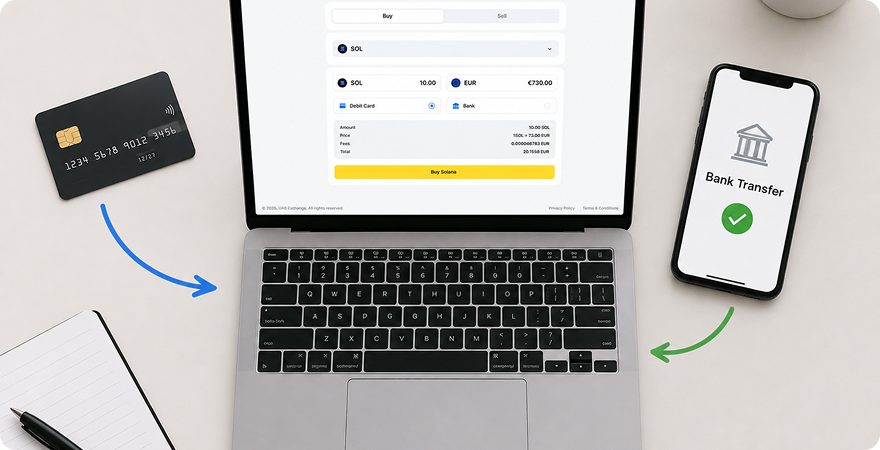
Speed is the entire advantage. A card purchase typically completes in under a minute. Funds clear, the trade executes, and you hold the asset before your coffee gets cold. The cost is meaningful: most exchanges charge between 2.5 and 4 percent in card processing fees, and the spread on a card-funded buy is often wider than the spread on a wire-funded buy at the same exchange. The all-in cost of buying $1,000 of Bitcoin with a card on most major exchanges lands between $40 and $60. The same purchase via bank transfer typically costs $5 to $15.


There’s also a counterparty risk worth flagging. Some banks treat crypto exchange card transactions as cash advances rather than purchases, which can trigger higher interest rates and immediate finance charges on credit cards. Check the cardholder agreement before assuming a card purchase will be treated like any other transaction.

Bank transfers

Cheaper, slower, and operationally more involved. SEPA transfers within the Eurozone typically settle same-day or next-day at near-zero cost. ACH transfers in the US take one to three business days. SWIFT wires internationally take one to five business days and carry fees on both ends. Faster options exist — SEPA Instant, Faster Payments in the UK, OSKO in Australia — but availability depends on both the sending bank and the exchange’s banking partnerships.


The slowness has a hidden cost: price exposure during the transit window. If you initiate a bank transfer to buy Bitcoin at $60,000 and the price moves to $63,000 before the funds arrive, you’ve effectively paid a five percent cost on the trade — much higher than the card fee would have been. For volatile assets in volatile markets, the speed advantage of card can outweigh the fee disadvantage.


A reasonable decision rule


For purchases under $500, the absolute dollar difference between card and bank transfer is small enough that convenience usually wins. Use card. For purchases between $500 and $5,000, the fee difference becomes meaningful but the price exposure risk during a bank transfer is moderate. Bank transfer is usually correct unless the market is moving sharply. Above $5,000, bank transfer is almost always correct on cost, and the price exposure can be managed by purchasing in tranches as funds clear.


Two practical patterns that work well

First, keep a stablecoin balance on the exchange to act as a “dry powder” buffer. This lets you buy instantly without card fees by converting stablecoins to the target asset, then top up the stablecoin balance via bank transfer at your leisure. Second, if you’re dollar-cost averaging on a fixed schedule, bank transfer with recurring deposits is the right pattern. The price exposure during transit averages out across many purchases, and the fee savings compound.

Card is for urgency. Bank transfer is for cost discipline. Stablecoin balance is for both.


How to Research a Crypto Asset Before You Buy It


The single highest-return hour in crypto trading is not spent watching charts. It’s spent researching the asset before the position is opened. A trader who spends sixty minutes doing structured due diligence on a token before buying typically outperforms one who buys on a thesis built from social media — not because the research produces better entry timing, but because it filters out the trades that should never have been opened in the first place.
A seven-question framework covers most of what matters.


You can use e-Pocket to send money to Panama today. To learn more about the countries on our extensive platform, read our blog page.


One: what does this protocol actually do, in one sentence?


If you cannot describe the protocol’s function in a single non-technical sentence, you don’t understand it well enough to take a position. Vague answers (“it’s a decentralised infrastructure layer for the next generation of web3”) are a red flag. Specific answers (“it’s a derivatives exchange that runs on its own appchain”) are workable.

Two: who is using it, and is that usage growing?


On-chain data tells you this. Active addresses, transaction count, total value locked (for DeFi protocols), revenue generated (for protocols that generate revenue). Look at the trend over the last six months. A protocol with stable or growing usage is fundamentally different from one with declining usage, regardless of how compelling the marketing is.

Three: where does the revenue come from, and who captures it?


Many crypto protocols have no revenue. That’s fine for early-stage infrastructure but troubling for protocols that have been operating for years. For protocols that do generate revenue, the question is whether token holders capture any of it. The answer is often no — and that fact alone reframes the investment thesis significantly.

Four: what’s the token supply schedule?


Most crypto tokens have ongoing emissions. A token with high inflation needs proportionally high demand growth just to stay flat in price. Check the unlock schedule for team and investor allocations. Large unlocks in the next twelve months are persistent overhead supply that affects price independent of any other factor.

Five: who are the major holders, and how concentrated is the supply?


Highly concentrated supply means a small number of wallets can move the market. Check the top one hundred holders on the relevant block explorer. If a handful of wallets control fifty percent or more of the circulating supply, you are effectively trading against their decisions.

Six: what does the team’s track record look like?


Has the founding team shipped previous products successfully? Are they doxxed? Do they have a credible history in the relevant domain? Anonymous teams are not automatically disqualified, but anonymity raises the threshold of proof required elsewhere.


Seven: what’s the bear case?


This is the question most traders skip. If you cannot articulate the strongest argument against the position you’re about to take, you are not ready to take it. The bear case forces you to identify what would have to be true for the thesis to fail, which is also the list of things to monitor after you enter.

Where to find the answers


The project’s documentation (not the marketing site). Token Terminal for revenue and fundamentals. Dune Analytics for on-chain metrics. The block explorer for holder concentration. Messari and DefiLlama for protocol-specific data. Twitter for narrative read, but with scepticism — the most enthusiastic accounts are often the most long.


Sixty minutes of structured research will not make every trade profitable. It will eliminate the trades that should never have been opened. That filter alone is worth more than any indicator.


How to Read Crypto Market Signals Before You Trade


The crypto information environment is loud. Telegram channels, X accounts, YouTube influencers, and trading newsletters produce enough content per hour to occupy a full-time attention budget, and most of it is noise. Cutting through to the signal that actually matters is less about consuming more and more about consuming better.
Five categories of data tend to lead price action. Everything else lags.


You can use e-Pocket to send money to Panama today. To learn more about the countries on our extensive platform, read our blog page.

On-chain flows


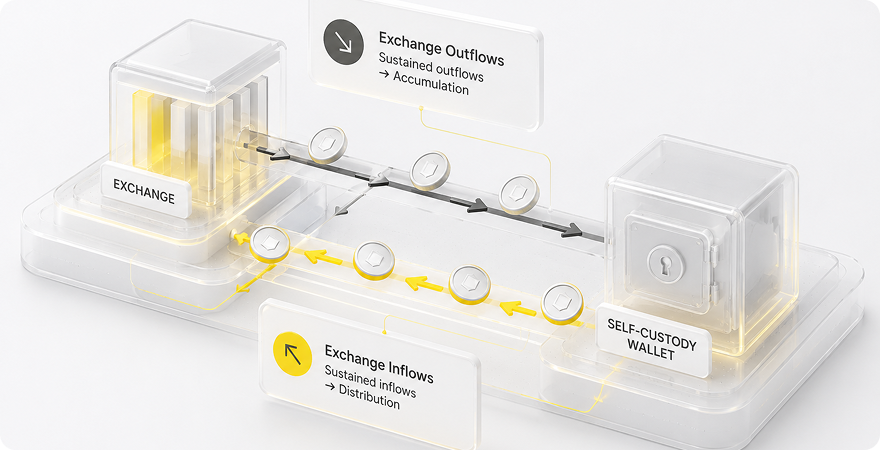
The movement of coins between exchanges and self-custody wallets is one of the few genuinely leading indicators in crypto. Sustained exchange outflows historically precede accumulation phases; sustained exchange inflows tend to precede distribution. The data is public and free — Glassnode, CryptoQuant, and Nansen publish dashboards — and most traders ignore it because it doesn’t produce a clean buy or sell signal. It produces a directional bias.


Stablecoin supply changes


Large mints of USDT or USDC are capital entering the crypto ecosystem; large burns are capital exiting. Net stablecoin supply growth over a one to two week window correlates strongly with subsequent market direction. This is not a precise timing tool, but it tells you which side of the trade has the wind behind it.

Funding rates and open interest


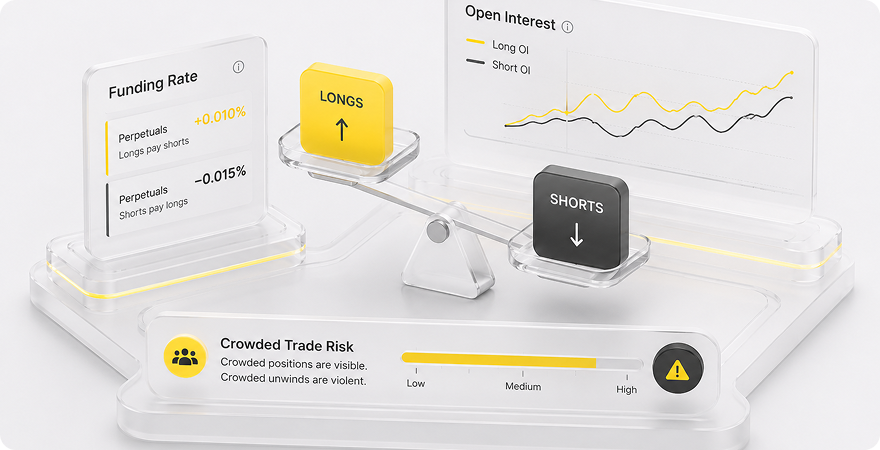
The derivatives market is several times larger than spot, which means derivatives positioning often determines short-term price action. Funding rates show whether longs or shorts are paying the premium; persistently positive funding signals an overcrowded long, persistently negative signals an overcrowded short. Combined with open interest trends, this gives a read on where the crowded trade is — and crowded trades unwind violently.

Macroeconomic context


Bitcoin in particular trades increasingly as a macro asset. US dollar strength (DXY), real yields, and central bank policy direction all matter. A trader who ignores macro because “crypto is independent” is operating on a thesis that has been wrong for most of the last four years. The relationship is not always linear, but it’s persistent.

Narrative momentum


This is the soft signal that’s hardest to measure and most often dismissed by analytical traders, which is exactly why it works. Sector rotation in crypto — AI tokens, real-world assets, Layer 2s, DePIN, memecoins — is driven by narrative more than by fundamentals. The trader who reads narrative early and exits when it goes mainstream consistently outperforms the trader who waits for confirmation.

What to ignore

Most chart pattern analysis below the four-hour timeframe is essentially noise. Most “whale alert” social posts are either too late to act on or are themselves a coordination signal rather than a genuine flow indicator. Most price predictions from anyone who isn’t disclosing their position are entertainment, not analysis.

A reasonable weekly routine


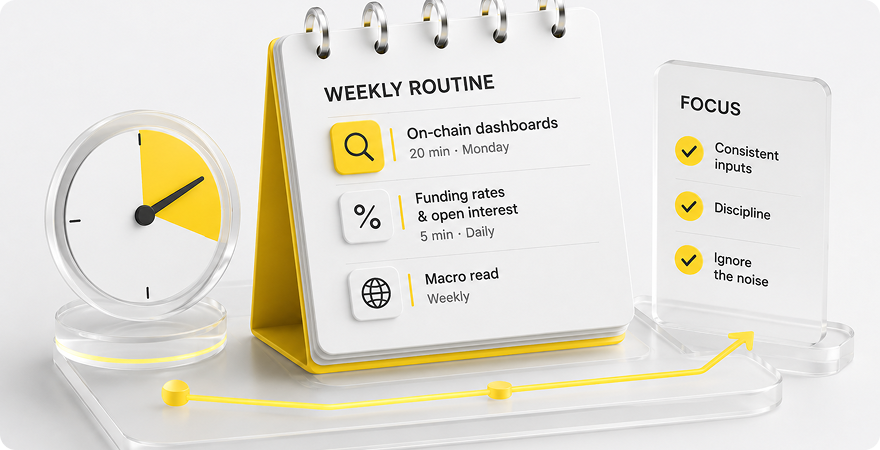
Twenty minutes on Monday morning checking on-chain dashboards. Five minutes daily checking funding rates and open interest. A weekly read on macro positioning. And a rolling list of three to five active narratives to track. That’s the entire input set for most traders below institutional size. Anything beyond it produces marginal information at increasing time cost.

The traders who consistently outperform are not the ones consuming the most market commentary. They’re the ones who’ve narrowed their inputs to the few categories that actually lead, and disciplined themselves to ignore everything else.

Cookies preferences

Others

Other uncategorized cookies are those that are being analyzed and have not been classified into a category as yet.

Necessary

Necessary
Necessary cookies are absolutely essential for the website to function properly. These cookies ensure basic functionalities and security features of the website, anonymously.

Advertisement

Advertisement cookies are used to provide visitors with relevant ads and marketing campaigns. These cookies track visitors across websites and collect information to provide customized ads.

Analytics

Analytical cookies are used to understand how visitors interact with the website. These cookies help provide information on metrics the number of visitors, bounce rate, traffic source, etc.

Functional

Functional cookies help to perform certain functionalities like sharing the content of the website on social media platforms, collect feedbacks, and other third-party features.

Performance

Performance cookies are used to understand and analyze the key performance indexes of the website which helps in delivering a better user experience for the visitors.