


From Retail to OTC: When Trade Size Changes Your Strategy


Positioning line: “From first trade to larger market moves, UAB Exchange supports a smarter way to explore crypto opportunities.” Target keyword: crypto OTC vs exchange Secondary keywords: large crypto trade slippage, when to use OTC crypto Search intent: Informational / commercial Funnel stage: MOFU — for traders graduating from retail size Meta description (152 ch): At some trade size, the exchange order book stops being your friend. The threshold where retail crypto trading turns into OTC, and how to recognise it. CTA: Request an OTC quote from UAB Exchange.

Most crypto traders never need to think about order book depth. At trade sizes below $10,000, almost any major exchange will fill at the price you see on screen. The market is liquid enough at retail size that the only fees that matter are the visible ones. This breaks at a specific threshold, and the threshold is not as high as most traders assume.

Where slippage starts to matter.
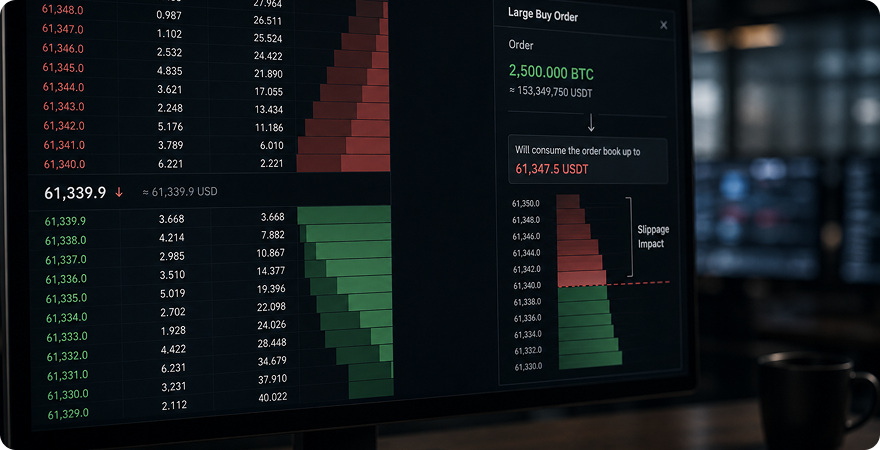
Slippage — the difference between the expected price and the executed price — scales with two variables: the size of your order relative to available liquidity and the asset’s volatility. For BTC/USDT on a major exchange, slippage typically remains under 10 basis points for orders up to about $100,000. For mid-cap altcoins, the same slippage threshold can be reached at $10,000 to $25,000. For thinly traded pairs, it can be reached at $5,000.

If you’ve ever placed a market order and noticed the fill price was meaningfully worse than the quoted price, you’ve crossed your threshold. The fix is not to keep using market orders. It’s to change the execution method.

Three execution methods, in order of size.

Market orders work fine at retail size. Limit orders, which only fill at a specified price or better, extend the workable range up to roughly the point where the order would consume more than two to three percent of the visible order book on a major venue. Algorithmic execution — TWAP, VWAP, or iceberg orders — extends the range further by breaking a large order into many smaller pieces over time, reducing market impact. And above a size that depends on the asset and the venue, the most efficient execution is not on the order book at all. It’s OTC.

What OTC actually is.

Over-the-counter trading is a direct, negotiated transaction between two counterparties, settled off the public order book. For crypto, this typically means a trade is quoted by an OTC desk based on the spot reference price plus a small spread, and settled bilaterally. The advantages: no slippage, no market impact, no public footprint of the trade, and bespoke settlement terms. The cost: a small spread above the screen price, which is almost always lower than the slippage and price impact would have been on the order book.

The threshold that makes OTC worthwhile.

A useful rule of thumb: if the trade size is large enough that executing it on the order book would visibly move the price, OTC is probably cheaper. For BTC and ETH, that typically begins around $250,000. For stablecoins, the threshold is much higher because liquidity is much deeper. For mid-cap altcoins, it can be as low as $50,000.

Beyond size: when else OTC makes sense.

Confidentiality, when the trade is large enough that public execution would signal intent to the market. Settlement flexibility, when the counterparty needs a non-standard settlement currency, network, or timing. And custody arrangements, when the trade involves a transfer of size that requires coordinated movement between custodial arrangements rather than a public withdrawal.

The graduation from retail to OTC is not about prestige. It’s about execution quality. The trader who keeps using market orders at OTC size is leaving meaningful money on the table on every trade.




How Digital Assets Are Reshaping Cross-Border Finance


Positioning line: “Digital assets are reshaping finance. UAB Exchange helps you stay informed, prepared, and connected to the market.” Target keyword: crypto cross-border payments. Secondary keywords: digital assets remittance, stablecoin payments. Search intent: Informational. Funnel stage: TOFU — thought leadership. Meta description (155 ch): Stablecoin settlement now moves more value across borders than some major remittance corridors. Why digital assets are quietly rewriting global finance. CTA: Read UAB Exchange’s quarterly market intelligence.

Most of the public conversation about digital assets is about prices. The more consequential story — the one that will define the next decade of global finance — is about settlement.

Traditional cross-border payments run on infrastructure that is sixty years old. A wire from a bank in London to a bank in Karachi typically touches four to six intermediaries, takes one to three business days, costs the sender between three and seven percent depending on amount, and arrives with foreign exchange margins that are rarely disclosed transparently. This is not because the technology is incapable. It’s because the rails are built around a settlement model designed for an era of telex machines and physical correspondent banking.

Stablecoins changed the underlying economics. A USDT or USDC transfer settles in minutes, costs cents in network fees regardless of size, and clears without intermediaries. The implication is not theoretical: stablecoin annual settlement volume now exceeds the total throughput of several major card networks, and in 2024 it began routinely exceeding Visa’s settlement volume on certain measurement windows. A meaningful share of that flow is genuine cross-border payments rather than crypto-native trading.

Where the impact is showing up first.

Three corridors are leading. Emerging-market remittance: workers in the Gulf and in Europe sending money to South Asia and Africa are increasingly settling in stablecoins on one end and converting at the destination, bypassing the traditional remittance rails entirely. B2B trade settlement: small and mid-size importers and exporters use stablecoin payment to avoid the friction of correspondent banking and to settle outside the working hours of traditional rails. Treasury operations: corporate treasurers in countries with capital controls or currency volatility use stablecoins as a digital dollar substitute when local options are constrained.

What this does not mean.

It does not mean banks are being replaced. The settlement layer is changing, but the customer relationship, regulatory compliance, fraud monitoring, and last-mile fiat conversion still sit with regulated financial institutions. The pattern emerging is closer to “stablecoins as plumbing” — invisible to most end users, but doing the actual work behind familiar interfaces.

The regulatory direction is clarifying, not tightening.

The EU’s MiCA framework, the UK’s stablecoin regime, Singapore’s payment services framework, and the US stablecoin legislation moving through Congress are different in detail but converging on a consistent shape: licensed issuers, full reserve backing, mandatory disclosures, and clear consumer protections. This is the opposite of the uncertainty that defined the previous cycle. For businesses considering integration, the regulatory path is now more visible than it has been at any point in the asset class’s history.

What this means for someone watching the space.

Two things. First, the most interesting use cases for digital assets are no longer speculative; they’re operational. Payment, settlement, treasury, and FX management are where the substantive integration is happening. Second, the line between “crypto company” and “financial company” is getting blurry — and the institutions that adapt early to the convergence will define the next phase of the industry.

UAB Exchange operates at this intersection. The digital-asset market is no longer a parallel financial system. It’s becoming part of the main one.

Cookies preferences

Others

Other uncategorized cookies are those that are being analyzed and have not been classified into a category as yet.

Necessary

Necessary
Necessary cookies are absolutely essential for the website to function properly. These cookies ensure basic functionalities and security features of the website, anonymously.

Advertisement

Advertisement cookies are used to provide visitors with relevant ads and marketing campaigns. These cookies track visitors across websites and collect information to provide customized ads.

Analytics

Analytical cookies are used to understand how visitors interact with the website. These cookies help provide information on metrics the number of visitors, bounce rate, traffic source, etc.

Functional

Functional cookies help to perform certain functionalities like sharing the content of the website on social media platforms, collect feedbacks, and other third-party features.

Performance

Performance cookies are used to understand and analyze the key performance indexes of the website which helps in delivering a better user experience for the visitors.