

From Retail to OTC: When Trade Size Changes Your Strategy
June 4, 2026

Positioning line: “From first trade to larger market moves, UAB Exchange supports a smarter way to explore crypto opportunities.” Target keyword: crypto OTC vs exchange Secondary keywords: large crypto trade slippage, when to use OTC crypto Search intent: Informational / commercial Funnel stage: MOFU — for traders graduating from retail size Meta description (152 ch): At some trade size, the exchange order book stops being your friend. The threshold where retail crypto trading turns into OTC, and how to recognise it. CTA: Request an OTC quote from UAB Exchange.
Most crypto traders never need to think about order book depth. At trade sizes below $10,000, almost any major exchange will fill at the price you see on screen. The market is liquid enough at retail size that the only fees that matter are the visible ones. This breaks at a specific threshold, and the threshold is not as high as most traders assume.
Where slippage starts to matter.
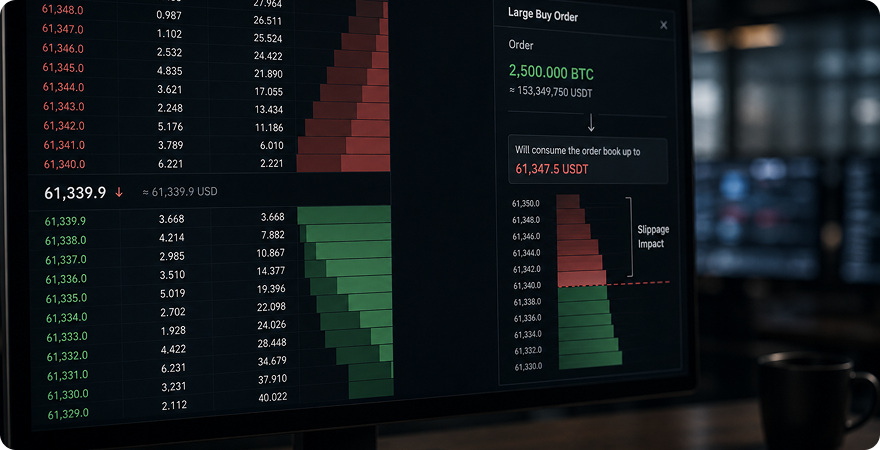
Slippage — the difference between the expected price and the executed price — scales with two variables: the size of your order relative to available liquidity and the asset’s volatility. For BTC/USDT on a major exchange, slippage typically remains under 10 basis points for orders up to about $100,000. For mid-cap altcoins, the same slippage threshold can be reached at $10,000 to $25,000. For thinly traded pairs, it can be reached at $5,000.
If you’ve ever placed a market order and noticed the fill price was meaningfully worse than the quoted price, you’ve crossed your threshold. The fix is not to keep using market orders. It’s to change the execution method.
Three execution methods, in order of size.
Market orders work fine at retail size. Limit orders, which only fill at a specified price or better, extend the workable range up to roughly the point where the order would consume more than two to three percent of the visible order book on a major venue. Algorithmic execution — TWAP, VWAP, or iceberg orders — extends the range further by breaking a large order into many smaller pieces over time, reducing market impact. And above a size that depends on the asset and the venue, the most efficient execution is not on the order book at all. It’s OTC.
What OTC actually is.
Over-the-counter trading is a direct, negotiated transaction between two counterparties, settled off the public order book. For crypto, this typically means a trade is quoted by an OTC desk based on the spot reference price plus a small spread, and settled bilaterally. The advantages: no slippage, no market impact, no public footprint of the trade, and bespoke settlement terms. The cost: a small spread above the screen price, which is almost always lower than the slippage and price impact would have been on the order book.

The threshold that makes OTC worthwhile.
A useful rule of thumb: if the trade size is large enough that executing it on the order book would visibly move the price, OTC is probably cheaper. For BTC and ETH, that typically begins around $250,000. For stablecoins, the threshold is much higher because liquidity is much deeper. For mid-cap altcoins, it can be as low as $50,000.
Beyond size: when else OTC makes sense.
Confidentiality, when the trade is large enough that public execution would signal intent to the market. Settlement flexibility, when the counterparty needs a non-standard settlement currency, network, or timing. And custody arrangements, when the trade involves a transfer of size that requires coordinated movement between custodial arrangements rather than a public withdrawal.

The graduation from retail to OTC is not about prestige. It’s about execution quality. The trader who keeps using market orders at OTC size is leaving meaningful money on the table on every trade.
Continue with UAB Exchange
Subscribe to our weekly market brief for structural analysis of crypto market dynamics, on-chain flows, and the macro context shaping digital-asset prices.
Subscribe