


Stablecoins Explained: USDT, USDC, and How They Hold Their Peg
August 6, 2026
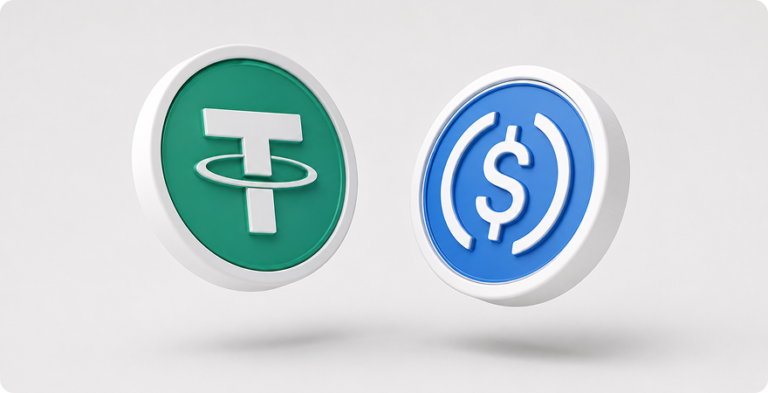
A stablecoin is a cryptocurrency designed to maintain a fixed value, typically pegged 1:1 to a fiat currency like the US dollar. The mechanical purpose: combine the speed and reach of crypto rails with the value stability of traditional currency. The market consequence: stablecoins have become the largest single use case in crypto by transaction volume, processing more settlement throughput annually than several major card networks.
The structural question is how a stablecoin holds its peg. There are three approaches, and the differences matter.
Fiat-backed stablecoins
The issuer holds reserves — typically cash and short-term Treasury securities — equal to or exceeding the supply of stablecoins in circulation. For every USDC or USDT in circulation, there’s supposed to be a dollar (or dollar-equivalent asset) sitting in a reserve account. The peg holds because users can, in principle, redeem their stablecoins for dollars at the issuer. This is the dominant model, accounting for the vast majority of stablecoin supply.
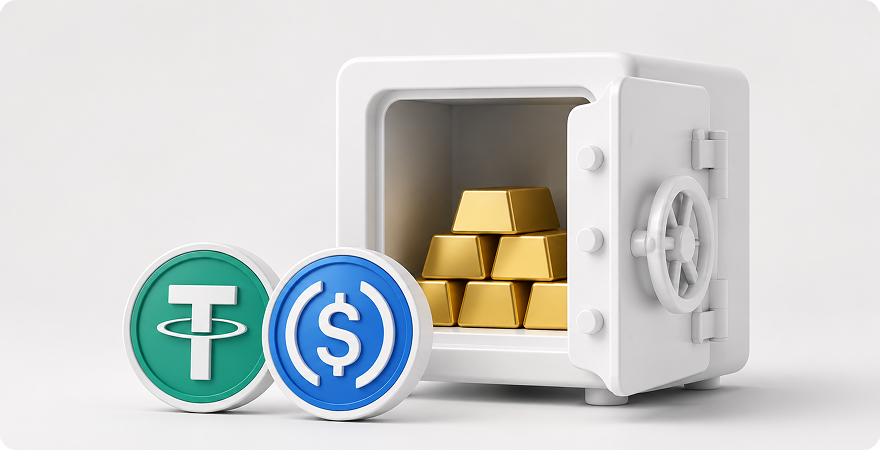
The two largest fiat-backed stablecoins are USDT (Tether) and USDC (Circle). They serve the same function but differ in regulatory posture and reserve composition transparency. USDC operates primarily under US regulatory oversight and publishes monthly attestations of reserves from a major accounting firm; the reserve composition skews heavily towards cash and short-term Treasuries. USDT operates with a more complex regulatory footprint and a longer history of questions around reserve composition; recent attestations show a similar Treasury-dominated reserve structure, but the reporting cadence and detail have historically been lighter than USDC’s.
In practice: USDT has wider acceptance across global exchanges (especially in Asia and emerging markets) and is the dominant stablecoin by trading volume. USDC has stronger institutional and US regulatory positioning and is the preferred stablecoin for many DeFi protocols and US-based payment integrations. For most users, both work fine. For users prioritizing regulatory clarity, USDC. For users prioritizing global liquidity, USDT.
Crypto-backed stablecoins
These maintain their peg by holding overcollateralised reserves of other cryptocurrencies. The largest example is DAI, issued by MakerDAO, which is backed by a basket of crypto assets (and increasingly real-world assets) at significantly more than 1:1 collateralisation. The advantage is that the system operates on-chain with transparent reserves. The disadvantage is capital efficiency — you need $1.50 or more of crypto collateral to mint $1 of stablecoin — and the residual exposure to a sharp decline in collateral asset prices.
Algorithmic stablecoins
These attempt to maintain the peg through algorithmic supply adjustments without holding equivalent reserves. The largest such project, Terra/UST, collapsed catastrophically in 2022 when the algorithmic mechanism failed under stress. Most market participants now treat purely algorithmic stablecoins as a structurally unstable design, and the category has largely been abandoned. Hybrid designs (partially algorithmic, partially collateralised) continue to exist but represent a small share of the stablecoin market.
What stablecoins are used for

Trading. The dominant pair on most crypto exchanges is asset-to-stablecoin rather than asset-to-fiat. Stablecoins allow traders to move out of price-volatile positions without exiting the crypto ecosystem entirely.
Cross-border payments. A USDT or USDC transfer settles in minutes for cents in fees, regardless of size or geography. This has produced rapid adoption in remittance corridors, B2B trade settlement, and treasury operations for businesses in countries with capital controls or currency volatility.
On-chain yield. Lending stablecoins through DeFi protocols or staking through CeFi platforms generates yield, currently in the range of 3–8% depending on the protocol and risk profile. This is broadly comparable to traditional money-market yields, with different risk characteristics.
Dollar exposure outside the banking system. For users in countries with weak local currencies or limited access to USD banking, stablecoins offer dollar-denominated exposure without requiring a US bank account.
Risks to be aware of

Issuer risk: the reserves backing a fiat-stablecoin are managed by a specific company, and the quality of those reserves matters. Regulatory risk: stablecoin regulation is evolving rapidly across jurisdictions, and rules can change. Smart-contract risk: stablecoins running on smart-contract platforms inherit any vulnerability in the underlying contracts. Concentration risk: USDT and USDC together represent the vast majority of stablecoin supply, and any meaningful failure at either would have systemic consequences.
For most users, stablecoins are infrastructure rather than investments. Boring, useful, and quietly carrying more of the world’s payment volume than most people realise.
Continue with UAB Exchange
Subscribe to our weekly market brief for structural analysis of crypto market dynamics, on-chain flows, and the macro context shaping digital-asset prices.
Subscribe