

What Is OTC Crypto Trading, and When Should You Use It?
August 6, 2026

OTC — over-the-counter — trading is one of the largest segments of crypto market activity that retail traders rarely see. Most of the volume in crypto above a certain size doesn’t happen on public order books. It happens in direct, negotiated transactions between two counterparties, settled bilaterally, with the price determined by quote rather than by depth.
For most retail traders, this distinction doesn’t matter. For anyone trading at meaningful size — institutional, treasury, high-net-worth — it’s the difference between executing well and executing poorly.
How an OTC desk actually works
A trader contacts the desk with a trade request: size, asset, direction, and any constraints on timing or settlement. The desk responds with a firm quote based on the current spot reference price plus a spread. The trader accepts or rejects. If accepted, the trade is confirmed, the desk sources the asset (from its own inventory, from a counterparty, or by hedging through the public market), and the trade settles directly between the two parties — typically the trader sends fiat to the desk’s bank account or stablecoin to its custody address, and the desk sends crypto to the trader’s wallet or custody address, on agreed terms.
The entire flow happens outside the public order book. No visible market impact, no slippage, no front-running risk from MEV or order book observers, no public footprint of the trade.
What OTC is good for
Size. The fundamental use case. Above the threshold where a single order would noticeably move the market, OTC is essentially always cheaper than order book execution. For BTC and ETH at major venues, this threshold is somewhere around $250,000–$500,000. For less liquid assets, it can be much lower. The trader who attempts a $1M altcoin trade on a public order book typically loses 2–5% to slippage and market impact; the same trade through an OTC desk typically costs 0.3–1% on the spread.
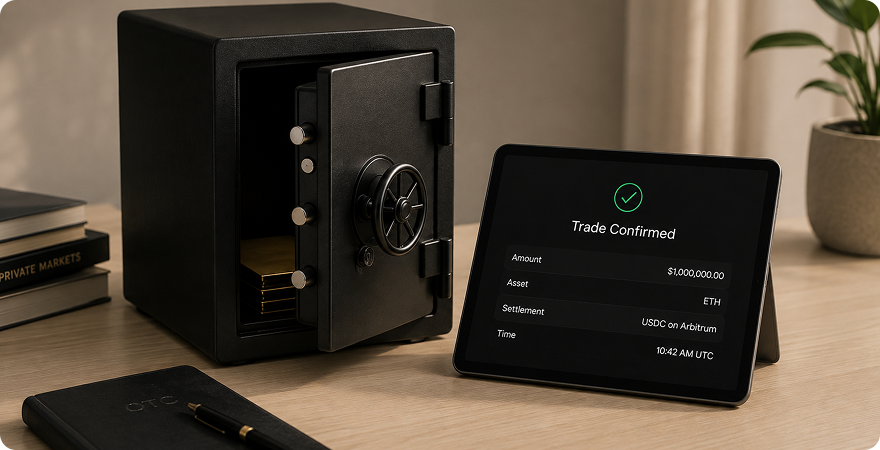
Confidentiality. OTC trades don’t appear on public order books or trade feeds. For institutional traders who don’t want to signal their positioning to the market, this matters. A large public buy is a market-moving event; a large OTC buy is invisible.
Settlement flexibility. OTC desks can typically accommodate non-standard settlement currencies, networks, or timing. Settling in EUR rather than USD. Settling in stablecoins on a specific chain. Splitting settlement across custody arrangements. These are often impossible or expensive on public exchanges and standard at OTC desks.
Coordination with custody operations. Large trades often involve coordinated movement between custody arrangements — a withdrawal from one custodian, a deposit to another, a transfer between cold storage and operational accounts. An OTC desk can structure the trade around these operational requirements rather than forcing them around the trade.
Who uses OTC desks
Institutional investors and family offices entering or exiting significant positions. Treasury operations at crypto-native companies managing operating capital. Miners selling production. Foundations and protocol treasuries managing native token holdings. High-net-worth individuals making large purchases or sales. Increasingly, businesses using stablecoin rails for cross-border payments at scale.
How OTC pricing works
The desk’s quote consists of the spot reference price plus a spread that depends on the asset’s liquidity, the trade size, and the desk’s risk appetite at that moment. For BTC and ETH at typical sizes, the spread is often in the range of 5–20 basis points above or below spot, depending on direction. For less liquid assets, spreads widen significantly. Most desks are transparent about their pricing methodology, and competitive desks will quote against each other for larger trades.
Counterparty considerations
OTC trading shifts the counterparty risk from the public exchange to the OTC desk. The trader needs to evaluate the desk’s reputation, settlement track record, regulatory standing, and operational capability. Established desks at regulated exchanges typically operate with strong KYC/AML compliance, audited custody arrangements, and clear legal frameworks. Less established desks carry more risk, and the spread savings can be eroded by counterparty losses if the desk fails to settle.
The minimum trade size, in practice
Most OTC desks operate with minimum trade sizes between $50,000 and $250,000, depending on the desk and the asset. Below those thresholds, the public order book remains the more efficient venue. Above them, OTC quickly becomes the right choice — and the gap widens as trade size grows.
For traders approaching the threshold where their trades start to noticeably affect the price they’re executing at, the upgrade to OTC execution is one of the highest-ROI operational changes available. It costs nothing to set up an account with a reputable desk. It saves meaningful basis points on every trade afterwards.
Continue with UAB Exchange
Subscribe to our weekly market brief for structural analysis of crypto market dynamics, on-chain flows, and the macro context shaping digital-asset prices.
Subscribe