

Crypto Fees Explained: Spreads, Network Fees, and Exchange Fee
August 6, 2026
The headline trading fee on a crypto exchange is rarely the largest cost of doing business there. The actual cost of a round-trip trade — buy, hold, and sell — is the sum of at least four fee components, and the visible commission is often the smallest. Traders who optimise only on the visible fee consistently overpay.
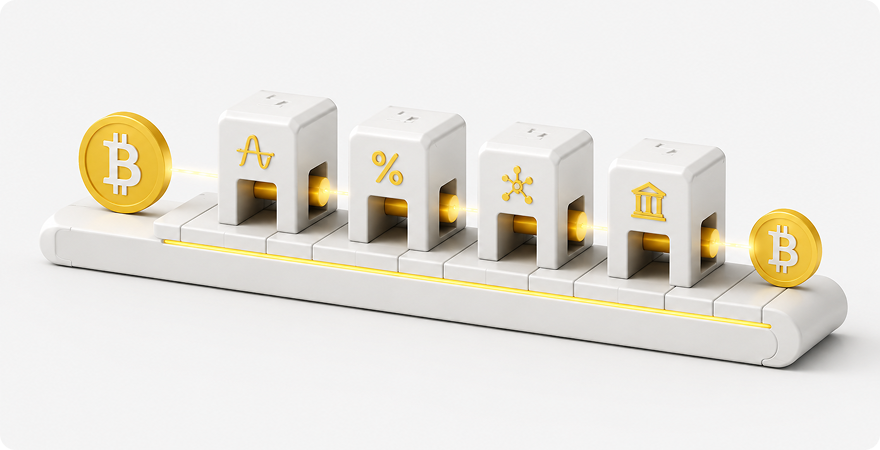
The four fee layers
Commission (or trading fee). The exchange’s charge for executing the trade, typically expressed as a percentage of the trade value. Standard ranges are 0.1% to 0.5% per side on spot trades, with higher rates for instant card-funded buys (often labelled as a “convenience fee” rather than a commission). Some exchanges offer tiered pricing based on volume; some offer “zero commission” headlines that recover the margin elsewhere.
Spread. The difference between the bid (highest price someone is willing to pay) and the ask (lowest price someone is willing to sell at). On a liquid asset at a major exchange, the spread on BTC/USDT is typically a few basis points. On a thinly traded asset or a smaller exchange, the spread can be 0.5% or wider. “Zero commission” exchanges typically have meaningfully wider spreads than commission-charging exchanges; the cost is the same, just relocated.
Network (gas) fees. The cost of recording the transaction on the underlying blockchain. Paid to network validators, not to the exchange. Network fees vary wildly: Bitcoin can range from $0.50 to $50 depending on network congestion; Ethereum from $1 to $200; transactions on Solana or Layer 2s typically run under $0.10. Network fees apply to deposits and withdrawals on most chains and matter most for users moving funds frequently or in small amounts.
Funding-method fees. The cost of getting fiat onto the exchange. Card deposits typically cost 2.5–4% of the transaction value. Bank transfers (SEPA in Europe, ACH in the US) typically cost $0 to $25 per transaction depending on the method and the exchange. International wires can cost $25–$50 plus correspondent banking fees. The right funding method depends on amount: card is cheapest in absolute dollars on very small purchases; bank transfer dominates everywhere else.
The round-trip cost is what matters
A useful exercise: calculate the total cost of buying $1,000 of Bitcoin and selling it back to fiat one month later, including all four fee layers, at the exchange you’re considering. The number that comes out is the round-trip cost. On most major regulated exchanges, this lands between 0.5% and 2% for bank-funded trades, and between 5% and 8% for card-funded trades. The dispersion across exchanges is meaningful — and almost entirely invisible if you’re only comparing headline commissions.
Where exchanges hide fees
Wider spreads on instant-buy or convert features. The “convert” feature on most exchanges lets you swap between assets in one click, with no visible commission. The cost is built into the rate, often 1–2% above the order book price. The visible simplicity costs you a meaningful percentage.
Higher withdrawal fees than network cost. Some exchanges charge a flat withdrawal fee that significantly exceeds the actual network fee. A $25 BTC withdrawal fee when the network is charging $2 is a 12x markup.
Spread on stablecoin conversion. Converting USDT to USDC (or vice versa) should be near-zero on cost. On many exchanges, it’s 0.2–0.5% via the spread. Over many trades, this adds up.
Margin and futures funding rates. Beyond spot trading, derivatives products carry funding rates that can dwarf trading commissions over time. A perpetual contract held through periods of high positive funding can lose 0.3–1% per day to funding alone.
A practical fee-optimisation framework
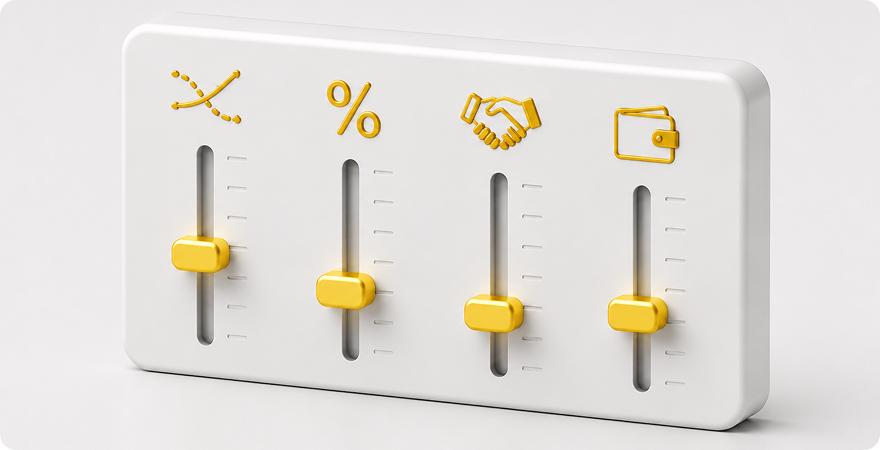
For one-time or occasional buys, the exchange’s fee structure matters less than the spread on your specific trade. For active trading, the maker-taker fee tier matters: providing liquidity (limit orders that don’t execute immediately) typically pays a lower fee than taking liquidity (market orders). For larger purchases, the OTC desk at the exchange — if available — often has tighter spreads than the public order book. For long-term holdings, the most meaningful fee is the withdrawal fee at the moment of moving funds to self-custody, which is paid once and otherwise irrelevant.
Fees are not where most beginners lose money. But they’re where most beginners overpay on every trade, and the cumulative cost over a multi-year holding period is meaningful.
Continue with UAB Exchange
Subscribe to our weekly market brief for structural analysis of crypto market dynamics, on-chain flows, and the macro context shaping digital-asset prices.
Subscribe