

How to Follow Crypto Markets Without Burning Out
July 21, 2026
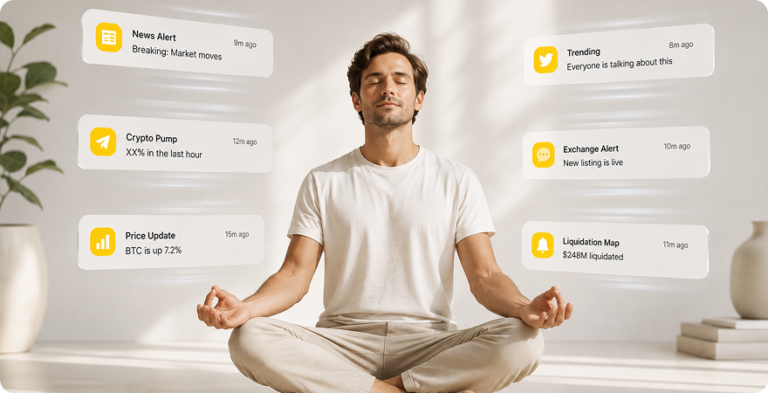
Crypto markets never close. The implicit pressure on participants is that they should also never close — that every overnight move, every weekend pump, every Asian-session liquidation requires real-time attention. This is wrong, and the cost of believing it is twofold. Your sleep deteriorates and your trading gets worse.
The traders who outperform over multi-year horizons share one habit that almost nobody talks about: they pay attention to less, not more. A structured, time-limited information routine outperforms continuous attention by a wide margin, for reasons that are mechanical rather than mystical.
Why continuous attention degrades decisions
Three effects compound. Reaction fatigue: every alert, every notification, every price movement triggers a small cognitive response. The cumulative effect over weeks is exhaustion, which manifests as worse risk management. Recency bias: the most recent price action dominates your perception of the market state, which means a trader watching every five-minute candle will systematically over-weight short-term noise relative to medium-term trends. And action bias: the more you watch, the more you feel pressure to act. Most of the time, the correct action is none.
A sustainable routine that takes thirty minutes per week
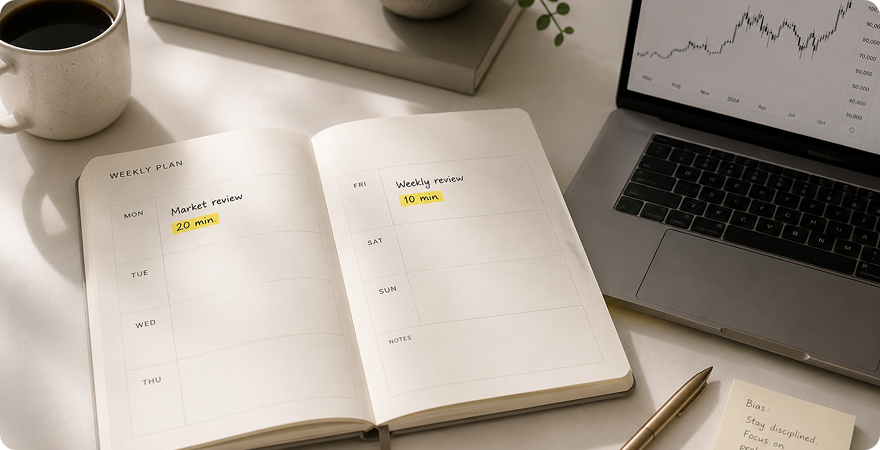
Twenty minutes on Monday morning, ten minutes on Friday afternoon, and that’s the entire weekly time budget for most non-professional traders.
Monday morning, twenty minutes: read one weekly market summary from a source you trust (the Bankless newsletter, The Block’s weekend wrap-up, or similar). Check the BTC and ETH weekly charts on the daily timeframe. Glance at funding rates and open interest. Look at on-chain exchange flow trends for the past week. That’s it. The goal is to enter the week with a directional bias, not a thesis on every asset.
Friday afternoon, ten minutes: review the week’s performance against your bias. Note one thing that surprised you. Note one thing you got right. Adjust the bias for next week. Don’t trade in this window — review only.
What to remove
Push notifications from price-alert apps, except for specific levels you’ve pre-decided matter. Telegram and Discord channels that produce more than ten messages per day. Twitter accounts that post more than twenty times per day on crypto. YouTube channels whose primary business model is keeping you watching. Any source that uses the word “MASSIVE” or “INSANE” in headlines. The selection criteria is signal density per minute, not entertainment value.
What to keep
One or two newsletters with high signal density. One or two long-form analysts who post weekly rather than hourly. Direct access to on-chain data dashboards (Glassnode, CryptoQuant, DefiLlama) that you check on your schedule, not theirs. The exchange’s official communications for the platforms you use. Macro information sources — Bloomberg, Reuters, FT — for the broader context that increasingly drives crypto.
The longer-term framing
Markets reward patience and punish urgency. A trader who participates with thirty minutes of weekly attention and a sustainable routine will, over five years, almost certainly outperform a trader who participates with thirty hours of weekly attention and a deteriorating one. The former has a sustainable practice. The latter has a hobby that’s slowly consuming them.

The market will be here next week. So should you be.
Continue with UAB Exchange
Subscribe to our weekly market brief for structural analysis of crypto market dynamics, on-chain flows, and the macro context shaping digital-asset prices.
Subscribe