

BTC vs ETH vs USDT: Which Should You Start With?
July 21, 2026
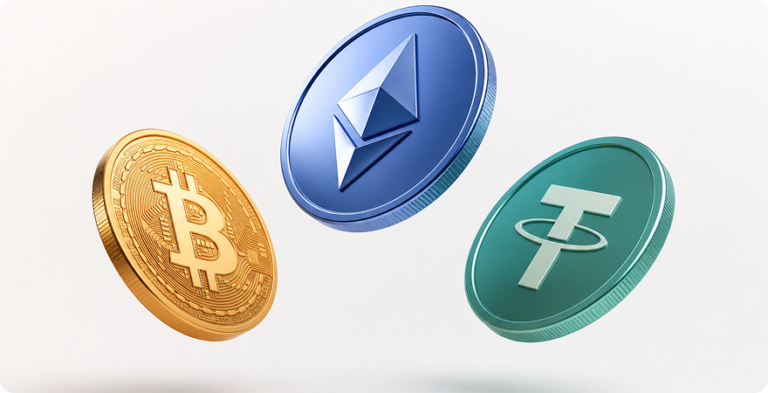
The three largest crypto assets by market capitalisation — Bitcoin, Ethereum, and Tether — are often grouped together in beginner conversations as if they’re interchangeable. They’re not. Each was designed to do a fundamentally different thing, and the right starting point depends entirely on what you’re trying to accomplish.
Bitcoin (BTC): digital scarcity
Bitcoin was designed as digital money with a fixed supply cap of 21 million coins, no central issuer, and no possibility of monetary debasement. The thesis is straightforward: a scarce, censorship-resistant, globally accessible asset has value as a store of wealth, particularly in an environment of expanding fiat money supply. Bitcoin’s track record is the longest in the asset class — 16 years and counting. It’s the most liquid, the most institutionally adopted, and the most volatility-tested. It does one thing — store value — and it does that one thing better than any alternative.

What Bitcoin doesn’t do: smart contracts, decentralised applications, programmable money. The base layer is intentionally simple and deliberately slow to change. If you want functionality beyond holding and transferring value, Bitcoin is not the asset.
Ethereum (ETH): programmable money
Ethereum was designed as a general-purpose computing platform that happens to be denominated in cryptocurrency. The ETH token is partly a store of value, partly a payment for using the network (the gas that powers transactions), and partly a productive asset that can be staked to earn yield. The thesis is that a global, decentralised computer with no single point of failure has economic value, and that value accrues to ETH because ETH is the asset that powers it.
Ethereum’s risk profile is higher than Bitcoin’s. The protocol is more complex, the upgrade cadence is faster, and competing smart-contract platforms — Solana, Avalanche, others — are credible. The upside profile is also higher because the addressable market for “programmable money” is larger than the addressable market for “digital gold.”
Tether (USDT): dollar exposure on-chain
USDT is not an investment in the same sense as BTC or ETH. It’s a stablecoin pegged 1:1 to the US dollar, designed to hold its value rather than appreciate. The thesis for owning USDT is access, not return: you hold USDT to participate in crypto markets without taking price risk, to send dollar-equivalent value across borders without going through the banking system, or to earn yield through lending and DeFi protocols.
USDT’s risk is not market volatility. It’s issuer risk. Tether (the company) is supposed to hold dollar-denominated reserves backing every USDT in circulation. The composition of those reserves has been a recurring topic of discussion across the industry, and the regulatory framework is still maturing. USDC, issued by Circle, is structurally similar but operates under tighter US regulatory oversight; the trade-off is slightly less ubiquitous availability across smaller venues.
Which one should you start with?
Start with BTC if your primary thesis is wealth preservation, you have a multi-year time horizon, and you want the lowest-complexity, longest-track-record exposure in the asset class. This describes most beginners accurately, even if it doesn’t feel exciting.

Start with ETH if you want exposure to the broader trajectory of crypto beyond store-of-value, you’re comfortable with higher volatility and more protocol risk, and you intend to engage actively with the on-chain ecosystem (staking, DeFi, NFTs) rather than just holding.
Start with USDT or USDC if you don’t yet have a directional view, you want to onboard capital into the crypto ecosystem without taking immediate price risk, or you’re using crypto rails for payment and transfer purposes rather than as an investment.
The most common mistake beginners make is choosing based on which asset has the most narrative momentum at the moment of decision. The right framework is choosing based on what you’re actually trying to do.
Continue with UAB Exchange
Subscribe to our weekly market brief for structural analysis of crypto market dynamics, on-chain flows, and the macro context shaping digital-asset prices.
Subscribe