

What Is OTC Crypto Trading, and When Should You Use It?


OTC — over-the-counter — trading is one of the largest segments of crypto market activity that retail traders rarely see. Most of the volume in crypto above a certain size doesn’t happen on public order books. It happens in direct, negotiated transactions between two counterparties, settled bilaterally, with the price determined by quote rather than by depth.

For most retail traders, this distinction doesn’t matter. For anyone trading at meaningful size — institutional, treasury, high-net-worth — it’s the difference between executing well and executing poorly.

How an OTC desk actually works

A trader contacts the desk with a trade request: size, asset, direction, and any constraints on timing or settlement. The desk responds with a firm quote based on the current spot reference price plus a spread. The trader accepts or rejects. If accepted, the trade is confirmed, the desk sources the asset (from its own inventory, from a counterparty, or by hedging through the public market), and the trade settles directly between the two parties — typically the trader sends fiat to the desk’s bank account or stablecoin to its custody address, and the desk sends crypto to the trader’s wallet or custody address, on agreed terms.

The entire flow happens outside the public order book. No visible market impact, no slippage, no front-running risk from MEV or order book observers, no public footprint of the trade.

What OTC is good for

Size. The fundamental use case. Above the threshold where a single order would noticeably move the market, OTC is essentially always cheaper than order book execution. For BTC and ETH at major venues, this threshold is somewhere around $250,000–$500,000. For less liquid assets, it can be much lower. The trader who attempts a $1M altcoin trade on a public order book typically loses 2–5% to slippage and market impact; the same trade through an OTC desk typically costs 0.3–1% on the spread.
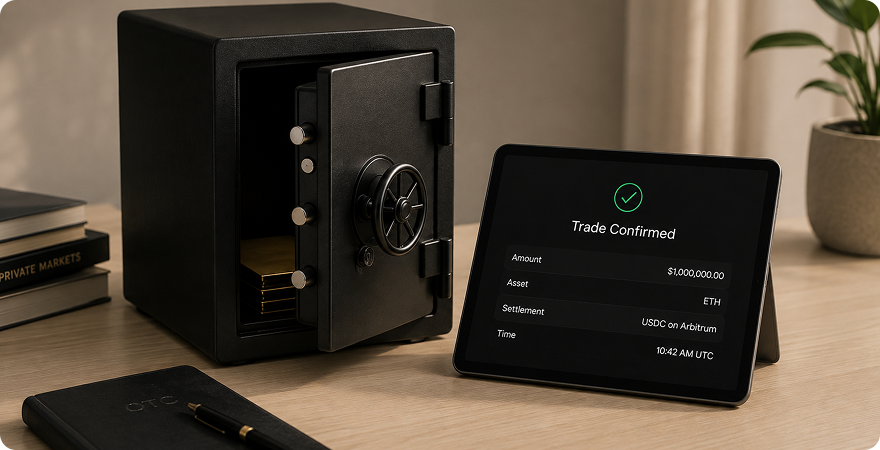
Confidentiality. OTC trades don’t appear on public order books or trade feeds. For institutional traders who don’t want to signal their positioning to the market, this matters. A large public buy is a market-moving event; a large OTC buy is invisible.

Settlement flexibility. OTC desks can typically accommodate non-standard settlement currencies, networks, or timing. Settling in EUR rather than USD. Settling in stablecoins on a specific chain. Splitting settlement across custody arrangements. These are often impossible or expensive on public exchanges and standard at OTC desks.

Coordination with custody operations. Large trades often involve coordinated movement between custody arrangements — a withdrawal from one custodian, a deposit to another, a transfer between cold storage and operational accounts. An OTC desk can structure the trade around these operational requirements rather than forcing them around the trade.

Who uses OTC desks

Institutional investors and family offices entering or exiting significant positions. Treasury operations at crypto-native companies managing operating capital. Miners selling production. Foundations and protocol treasuries managing native token holdings. High-net-worth individuals making large purchases or sales. Increasingly, businesses using stablecoin rails for cross-border payments at scale.

How OTC pricing works

The desk’s quote consists of the spot reference price plus a spread that depends on the asset’s liquidity, the trade size, and the desk’s risk appetite at that moment. For BTC and ETH at typical sizes, the spread is often in the range of 5–20 basis points above or below spot, depending on direction. For less liquid assets, spreads widen significantly. Most desks are transparent about their pricing methodology, and competitive desks will quote against each other for larger trades.

Counterparty considerations

OTC trading shifts the counterparty risk from the public exchange to the OTC desk. The trader needs to evaluate the desk’s reputation, settlement track record, regulatory standing, and operational capability. Established desks at regulated exchanges typically operate with strong KYC/AML compliance, audited custody arrangements, and clear legal frameworks. Less established desks carry more risk, and the spread savings can be eroded by counterparty losses if the desk fails to settle.

The minimum trade size, in practice

Most OTC desks operate with minimum trade sizes between $50,000 and $250,000, depending on the desk and the asset. Below those thresholds, the public order book remains the more efficient venue. Above them, OTC quickly becomes the right choice — and the gap widens as trade size grows.

For traders approaching the threshold where their trades start to noticeably affect the price they’re executing at, the upgrade to OTC execution is one of the highest-ROI operational changes available. It costs nothing to set up an account with a reputable desk. It saves meaningful basis points on every trade afterwards.


How to Build Your First Crypto Portfolio 
(A Framework)


Most beginner crypto portfolios are not built. They accumulate. A position here because of an article. A position there because of a friend’s recommendation. A few tokens picked up during a frenzy and forgotten. After two years, the resulting portfolio is a museum of past decisions, with no coherent thesis tying the holdings together. This is the default and it produces predictable underperformance.

A built portfolio looks different. It starts from a target allocation, uses each asset to fill a specific role, and gets rebalanced on a schedule rather than on emotion.

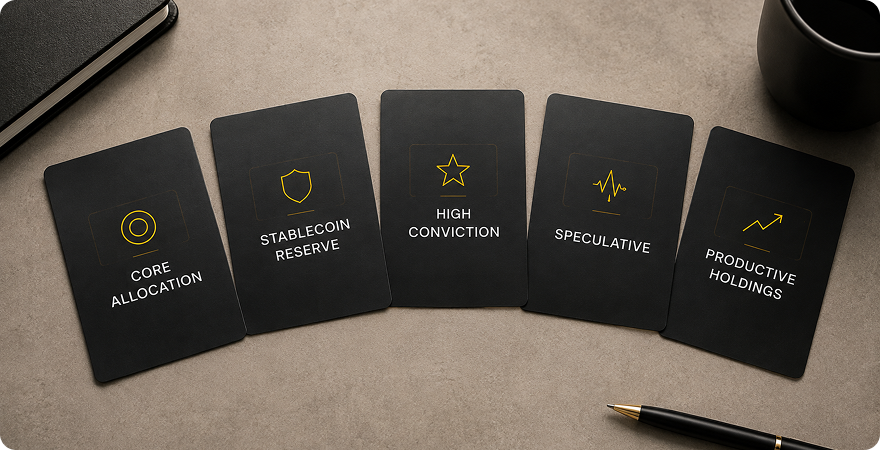
The five-bucket framework

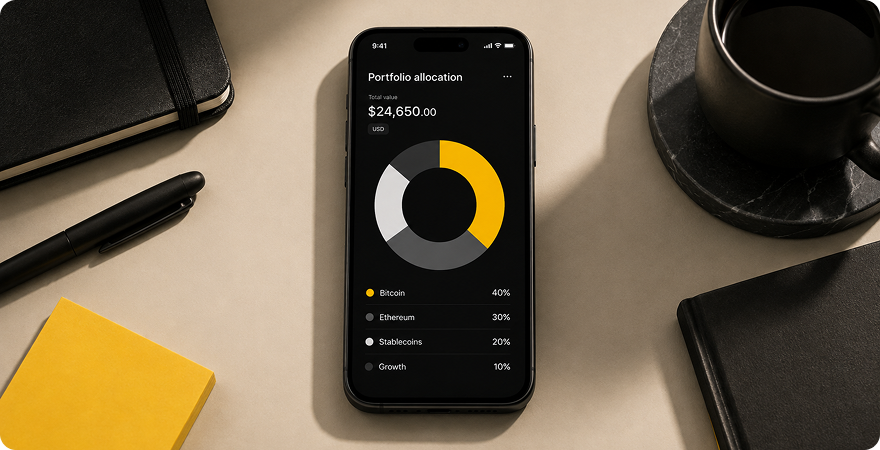
Core allocation (50–70%). Bitcoin and Ethereum, in some ratio. These are the assets with the longest track records, the deepest liquidity, the most institutional adoption, and the lowest probability of going to zero. A reasonable starting split is 60/40 BTC/ETH or 70/30, depending on whether your conviction skews more towards the store-of-value thesis (favours BTC) or the programmable-money thesis (favours ETH). The core allocation is the part of the portfolio that’s not supposed to be exciting. It’s the foundation that the rest of the portfolio sits on.

Stablecoin reserve (10–20%). USDC, USDT, or a mix. This bucket serves three purposes: dry powder for buying during drawdowns, yield generation through lending or DeFi, and a defensive layer that doesn’t get destroyed during sharp market declines. Many beginners under-allocate to stablecoins because they feel like sitting in cash during a market they’re trying to participate in. The right framing: the stablecoin allocation is what allows you to be aggressive in the rest of the portfolio when others can’t.

High-conviction non-core (10–25%). Two to five assets you’ve researched and have a specific thesis on. This might be a Layer 1 platform you believe in, a DeFi protocol with genuine revenue, a infrastructure token with real adoption. Each position in this bucket should have a written thesis, a sizing decision, and pre-defined exits. Limit position sizes within this bucket so that no single asset exceeds 10% of the total portfolio.

Speculative (0–10%). Smaller-cap tokens, narrative trades, early-stage positions. The bucket where you take asymmetric upside bets with capital you can fully lose. Discipline here matters more than anywhere else: the bucket should be sized so that going to zero is annoying but not catastrophic, and individual positions should never exceed 2–3% of the total portfolio. This is also the bucket where most beginners over-allocate, treating speculative trades as the main event rather than the satellite.

Productive holdings (0–15%). Assets being put to work — staked ETH earning protocol rewards, BTC earning yield through reputable lending platforms, stablecoins in DeFi lending markets. This isn’t a separate asset bucket so much as an active state for assets in the other buckets. The yield is meaningful at the portfolio level (3–7% on stablecoins, 3–4% on staked ETH) but introduces smart-contract and counterparty risk that has to be sized accordingly.

Rebalancing rules

A portfolio without rebalancing rules drifts: the winners grow as a share of the total, the losers shrink, and the original target allocation becomes a memory. Two approaches work for beginners.

Calendar rebalancing. Once a quarter, sell some of what’s grown beyond target and buy what’s fallen below. This is simple, predictable, and tax-aware (you can choose timing for tax optimisation). The downside is that you rebalance whether the market wants it or not.

Threshold rebalancing. Rebalance when any single allocation drifts more than 5 percentage points from its target. This is more market-responsive but requires more attention. Most beginners are better served by calendar rebalancing.

What to avoid

Diversifying into 30+ assets. Beyond about 10–15 holdings, additional positions don’t add diversification — they just add complexity. A focused portfolio you understand outperforms a diversified portfolio you don’t.

Position sizing by enthusiasm. The position size of any asset should be determined by the framework, not by how excited you are about it. The most overweighted positions in retail portfolios are consistently the ones that underperform most.

Treating the portfolio as static. Markets change, theses get proven wrong, new opportunities appear. The portfolio framework is a starting point that should evolve based on new information, but it should evolve deliberately — not reactively to the last thing you read.

A portfolio built on purpose, even an imperfect one, beats a portfolio that just happened. The discipline of structure compounds.


Stablecoins Explained: USDT, USDC, and How They Hold Their Peg


A stablecoin is a cryptocurrency designed to maintain a fixed value, typically pegged 1:1 to a fiat currency like the US dollar. The mechanical purpose: combine the speed and reach of crypto rails with the value stability of traditional currency. The market consequence: stablecoins have become the largest single use case in crypto by transaction volume, processing more settlement throughput annually than several major card networks.

The structural question is how a stablecoin holds its peg. There are three approaches, and the differences matter.

Fiat-backed stablecoins

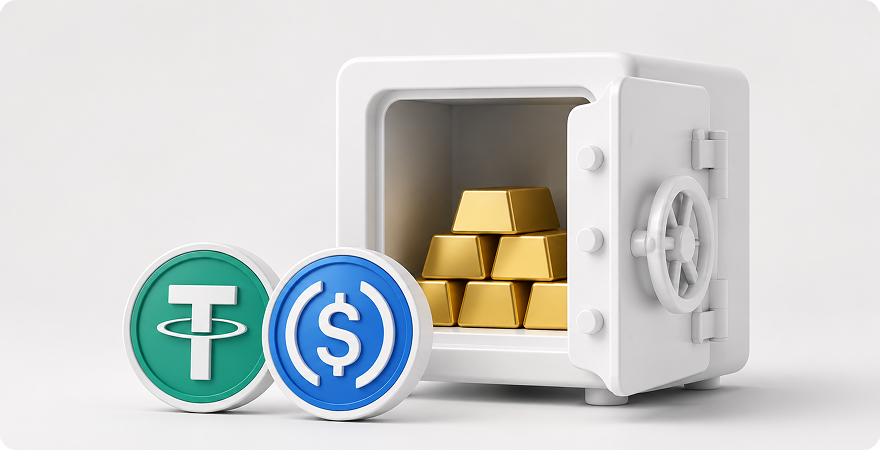
The issuer holds reserves — typically cash and short-term Treasury securities — equal to or exceeding the supply of stablecoins in circulation. For every USDC or USDT in circulation, there’s supposed to be a dollar (or dollar-equivalent asset) sitting in a reserve account. The peg holds because users can, in principle, redeem their stablecoins for dollars at the issuer. This is the dominant model, accounting for the vast majority of stablecoin supply.

The two largest fiat-backed stablecoins are USDT (Tether) and USDC (Circle). They serve the same function but differ in regulatory posture and reserve composition transparency. USDC operates primarily under US regulatory oversight and publishes monthly attestations of reserves from a major accounting firm; the reserve composition skews heavily towards cash and short-term Treasuries. USDT operates with a more complex regulatory footprint and a longer history of questions around reserve composition; recent attestations show a similar Treasury-dominated reserve structure, but the reporting cadence and detail have historically been lighter than USDC’s.

In practice: USDT has wider acceptance across global exchanges (especially in Asia and emerging markets) and is the dominant stablecoin by trading volume. USDC has stronger institutional and US regulatory positioning and is the preferred stablecoin for many DeFi protocols and US-based payment integrations. For most users, both work fine. For users prioritizing regulatory clarity, USDC. For users prioritizing global liquidity, USDT.

Crypto-backed stablecoins

These maintain their peg by holding overcollateralised reserves of other cryptocurrencies. The largest example is DAI, issued by MakerDAO, which is backed by a basket of crypto assets (and increasingly real-world assets) at significantly more than 1:1 collateralisation. The advantage is that the system operates on-chain with transparent reserves. The disadvantage is capital efficiency — you need $1.50 or more of crypto collateral to mint $1 of stablecoin — and the residual exposure to a sharp decline in collateral asset prices.

Algorithmic stablecoins

These attempt to maintain the peg through algorithmic supply adjustments without holding equivalent reserves. The largest such project, Terra/UST, collapsed catastrophically in 2022 when the algorithmic mechanism failed under stress. Most market participants now treat purely algorithmic stablecoins as a structurally unstable design, and the category has largely been abandoned. Hybrid designs (partially algorithmic, partially collateralised) continue to exist but represent a small share of the stablecoin market.

What stablecoins are used for

Trading. The dominant pair on most crypto exchanges is asset-to-stablecoin rather than asset-to-fiat. Stablecoins allow traders to move out of price-volatile positions without exiting the crypto ecosystem entirely.

Cross-border payments. A USDT or USDC transfer settles in minutes for cents in fees, regardless of size or geography. This has produced rapid adoption in remittance corridors, B2B trade settlement, and treasury operations for businesses in countries with capital controls or currency volatility.

On-chain yield. Lending stablecoins through DeFi protocols or staking through CeFi platforms generates yield, currently in the range of 3–8% depending on the protocol and risk profile. This is broadly comparable to traditional money-market yields, with different risk characteristics.

Dollar exposure outside the banking system. For users in countries with weak local currencies or limited access to USD banking, stablecoins offer dollar-denominated exposure without requiring a US bank account.

Risks to be aware of

Issuer risk: the reserves backing a fiat-stablecoin are managed by a specific company, and the quality of those reserves matters. Regulatory risk: stablecoin regulation is evolving rapidly across jurisdictions, and rules can change. Smart-contract risk: stablecoins running on smart-contract platforms inherit any vulnerability in the underlying contracts. Concentration risk: USDT and USDC together represent the vast majority of stablecoin supply, and any meaningful failure at either would have systemic consequences.

For most users, stablecoins are infrastructure rather than investments. Boring, useful, and quietly carrying more of the world’s payment volume than most people realise.


Crypto Fees Explained: Spreads, Network Fees, and Exchange Fee


The headline trading fee on a crypto exchange is rarely the largest cost of doing business there. The actual cost of a round-trip trade — buy, hold, and sell — is the sum of at least four fee components, and the visible commission is often the smallest. Traders who optimise only on the visible fee consistently overpay.

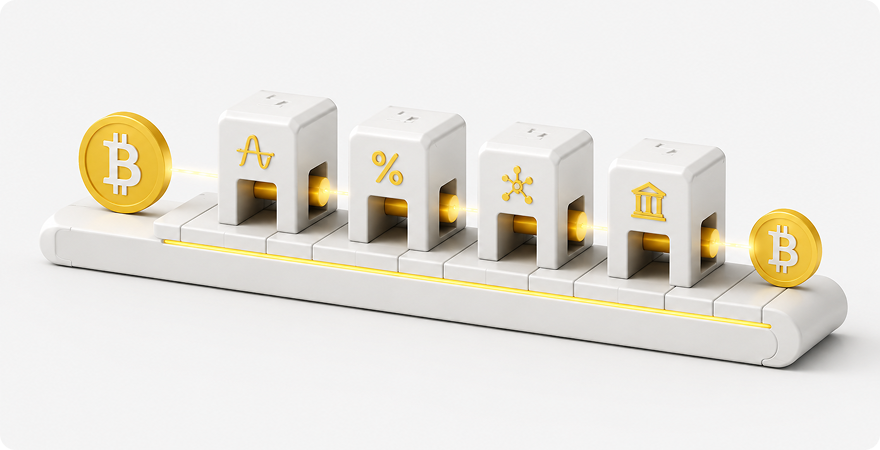
The four fee layers

Commission (or trading fee). The exchange’s charge for executing the trade, typically expressed as a percentage of the trade value. Standard ranges are 0.1% to 0.5% per side on spot trades, with higher rates for instant card-funded buys (often labelled as a “convenience fee” rather than a commission). Some exchanges offer tiered pricing based on volume; some offer “zero commission” headlines that recover the margin elsewhere.

Spread. The difference between the bid (highest price someone is willing to pay) and the ask (lowest price someone is willing to sell at). On a liquid asset at a major exchange, the spread on BTC/USDT is typically a few basis points. On a thinly traded asset or a smaller exchange, the spread can be 0.5% or wider. “Zero commission” exchanges typically have meaningfully wider spreads than commission-charging exchanges; the cost is the same, just relocated.

Network (gas) fees. The cost of recording the transaction on the underlying blockchain. Paid to network validators, not to the exchange. Network fees vary wildly: Bitcoin can range from $0.50 to $50 depending on network congestion; Ethereum from $1 to $200; transactions on Solana or Layer 2s typically run under $0.10. Network fees apply to deposits and withdrawals on most chains and matter most for users moving funds frequently or in small amounts.

Funding-method fees. The cost of getting fiat onto the exchange. Card deposits typically cost 2.5–4% of the transaction value. Bank transfers (SEPA in Europe, ACH in the US) typically cost $0 to $25 per transaction depending on the method and the exchange. International wires can cost $25–$50 plus correspondent banking fees. The right funding method depends on amount: card is cheapest in absolute dollars on very small purchases; bank transfer dominates everywhere else.

The round-trip cost is what matters

A useful exercise: calculate the total cost of buying $1,000 of Bitcoin and selling it back to fiat one month later, including all four fee layers, at the exchange you’re considering. The number that comes out is the round-trip cost. On most major regulated exchanges, this lands between 0.5% and 2% for bank-funded trades, and between 5% and 8% for card-funded trades. The dispersion across exchanges is meaningful — and almost entirely invisible if you’re only comparing headline commissions.

Where exchanges hide fees

Wider spreads on instant-buy or convert features. The “convert” feature on most exchanges lets you swap between assets in one click, with no visible commission. The cost is built into the rate, often 1–2% above the order book price. The visible simplicity costs you a meaningful percentage.

Higher withdrawal fees than network cost. Some exchanges charge a flat withdrawal fee that significantly exceeds the actual network fee. A $25 BTC withdrawal fee when the network is charging $2 is a 12x markup.

Spread on stablecoin conversion. Converting USDT to USDC (or vice versa) should be near-zero on cost. On many exchanges, it’s 0.2–0.5% via the spread. Over many trades, this adds up.

Margin and futures funding rates. Beyond spot trading, derivatives products carry funding rates that can dwarf trading commissions over time. A perpetual contract held through periods of high positive funding can lose 0.3–1% per day to funding alone.

A practical fee-optimisation framework

For one-time or occasional buys, the exchange’s fee structure matters less than the spread on your specific trade. For active trading, the maker-taker fee tier matters: providing liquidity (limit orders that don’t execute immediately) typically pays a lower fee than taking liquidity (market orders). For larger purchases, the OTC desk at the exchange — if available — often has tighter spreads than the public order book. For long-term holdings, the most meaningful fee is the withdrawal fee at the moment of moving funds to self-custody, which is paid once and otherwise irrelevant.

Fees are not where most beginners lose money. But they’re where most beginners overpay on every trade, and the cumulative cost over a multi-year holding period is meaningful.


Self-Custody vs Exchange Custody: Where Should Your Crypto Live?


Where your crypto lives is one of the few decisions in this asset class with binary outcomes. Get it right and the choice never matters. Get it wrong — usually because an exchange fails — and the consequences are total. Understanding the trade-off is more important than most of the trading decisions that follow it.

Exchange custody

When you buy cryptocurrency on an exchange and leave it there, the exchange holds the private keys. You hold an account balance, which is functionally a claim against the exchange. The exchange typically pools customer assets in shared wallets, with internal accounting that tracks individual balances. Most of the time, this works exactly as advertised.

The advantages are real. Convenience: trading, withdrawing, and converting between assets happens instantly. Operational simplicity: no seed phrases to manage, no transactions to sign, no risk of self-inflicted loss. Recovery: if you forget your password, the exchange can reset it. Customer support: actual humans you can contact when something goes wrong.

The risk is also real. Exchanges fail. Mt. Gox, QuadrigaCX, FTX, Celsius — each was the largest or one of the largest exchanges in its market at the time of collapse. In every case, customers with funds on the exchange faced significant losses, lengthy bankruptcy proceedings, and recoveries that ranged from partial to zero. The phrase “not your keys, not your coins” is not paranoia. It’s a description of the legal reality.

Self-custody

When you withdraw cryptocurrency to a wallet whose private keys you control, the exchange’s solvency stops mattering. The funds are yours in the most literal sense — there’s no intermediary that can fail, freeze, or refuse withdrawal. The trade-off is that the responsibility for security shifts entirely to you.

The advantages: total control, zero counterparty risk, censorship resistance, and access to the full range of on-chain applications (DeFi, staking, NFTs) that exchange custody often restricts or simplifies. The disadvantages: total responsibility for security, the operational complexity of managing seed phrases and signing transactions, and the irreversibility of mistakes. If you lose your seed phrase, the funds are unrecoverable. If you sign a malicious transaction, the funds are gone. There is no support line.

The two practical custody options for self-custody

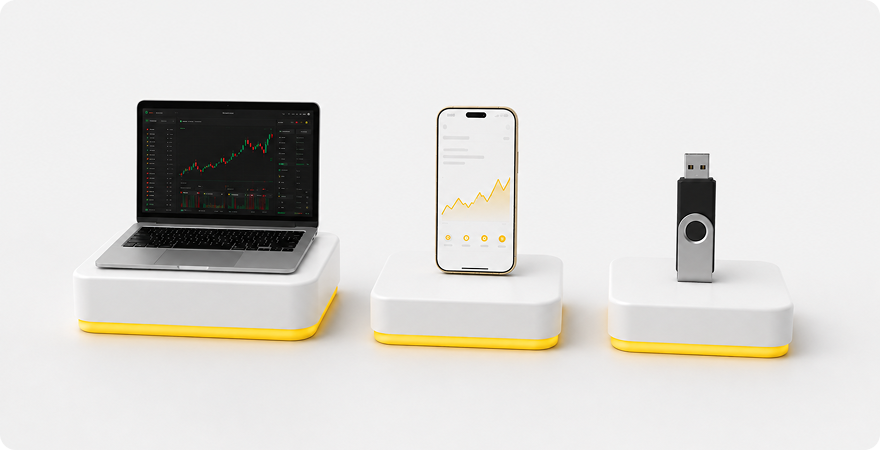
Software wallets (MetaMask, Phantom, Rabby, mobile wallets) keep the private keys on a connected device. Convenient for daily use; vulnerable to malware, phishing, and any compromise of the device. Appropriate for working balances — funds you’re actively using — not for long-term holdings.

Hardware wallets (Ledger, Trezor, GridPlus, Keystone) keep the private keys on a dedicated offline device that signs transactions when connected. The device never exposes the keys to the connected computer. This is dramatically more secure than software wallets and is the standard for any meaningful long-term holding. The cost is a one-time hardware purchase (typically $80–$200) and a small amount of operational friction on every transaction.

A reasonable framework for where funds should live

Trading and short-term funds. Stay on the exchange you’re trading from. The withdrawal friction would cost more than the marginal custody risk on small, actively-managed balances.

Medium-term holdings. Software wallet (mobile or browser extension) for funds you want accessible for on-chain activity but don’t need to trade frequently. Limit balances to what you’d be comfortable losing to a device compromise.

Long-term core holdings. Hardware wallet, full stop. Any balance large enough that its loss would meaningfully affect you belongs on a hardware wallet. The setup takes thirty minutes. The peace of mind is permanent.

The seed phrase is the actual asset

Whatever your custody approach, the seed phrase backing the wallet is the thing being protected. Write it down on paper or steel (not on a phone, not in cloud storage, not in a password manager), store it in at least two physical locations, and never share it with anyone for any reason. Every legitimate support process in crypto operates without ever needing your seed phrase. If anyone asks for it, it’s a scam.

The custody choice is not technically complex. It’s just consequential. The half-hour spent setting up proper custody is one of the highest-return uses of time in this asset class.


Understanding Crypto Market Cycles: Bull, Bear, and Accumulation


Crypto markets have moved in roughly four-year cycles since the asset class became investable, and although every cycle is different in detail, the structural pattern has been remarkably consistent. Understanding where you are in the cycle is a meaningfully better predictor of medium-term returns than any analysis of individual assets.

The four phases

Accumulation. Following a major drawdown, prices stabilise at depressed levels. Trading volume is low, retail attention is minimal, media coverage is negative or absent, and most participants who remain are long-term holders. The price action is choppy and unrewarding; the structural conditions are excellent. Accumulation phases historically last six to twelve months and offer the best risk-adjusted entry points of any phase, which is why they’re also the phase during which retail participation is lowest.

Markup. Prices begin trending higher with rising volume. Early signs include sustained breaks above multi-month resistance, on-chain accumulation by long-term holders converting to spending behaviour, and the first wave of new participants entering the market. Media tone shifts from negative to neutral. Sector rotation begins: Bitcoin leads first, then large-cap altcoins, then mid-caps, then small-caps in roughly that order. Markup phases historically last twelve to eighteen months and produce most of the returns of the cycle.

Distribution. Prices reach new all-time highs across most assets, retail participation peaks, media coverage becomes saturated with enthusiasm, leverage builds across the market, and on-chain data shows long-term holders distributing into retail demand. The structural conditions are deteriorating while the surface signals look the best they’ve ever looked. This is the phase during which most retail entry happens and most professional exit happens. Distribution typically lasts three to six months.

Bear market. Prices decline sharply from the peak, often by 70–85% on Bitcoin and 85–95% on altcoins. The initial decline is fast and shocking; the longer pattern is a grinding sideways-to-down market that exhausts even committed participants. Failed protocols and leveraged participants are flushed out. Retail attention collapses. The cycle resets and the next accumulation phase begins. Bear markets historically last twelve to eighteen months.

What drives the cycle

Bitcoin’s halving — the protocol-scheduled reduction of new coin issuance every four years — is the most-cited driver. The supply shock from the halving has historically preceded a major bull cycle by roughly twelve months. The supply effect is real, but it’s not the entire mechanism: the cycle is also driven by liquidity conditions (monetary policy, dollar strength), narrative cycles (every cycle has its dominant theme: ICOs in 2017, DeFi and NFTs in 2021, AI and real-world assets in 2024–25), and pure reflexivity (price action driving sentiment driving more price action).

Where you are matters more than what you pick

Almost every asset rises during markup and falls during bear markets. The dispersion between assets matters at the margins; the dispersion between phases is enormous. A mediocre asset bought in early markup outperforms an excellent asset bought in late distribution by a factor of five or more on a typical cycle.

How to estimate where you are

No indicator gives a clean read, but several together produce a useful picture. The Pi Cycle Top, MVRV Z-score, and on-chain long-term holder distribution metrics have historically aligned around major tops. The 200-week moving average and capitulation indicators have aligned around major bottoms. Retail attention metrics — Google Trends for “Bitcoin,” App Store rankings for crypto exchange apps, mainstream media tone — give the soft confirmation that quantitative metrics suggest.

The implication for behaviour

Aggressive positioning in late accumulation and early markup. Defensive positioning in late distribution. Patience and structural accumulation in bear markets, when the headlines say the asset class is dead. The participants who consistently outperform across cycles are the ones whose risk appetite is inverse to retail sentiment, not aligned with it.


How to Build a Crypto Trading Plan
(Step by Step)


The single behavioural change that improves new traders’ results the most is also the most boring: writing down a plan before the trade, and following it during. This is not glamorous, and it does not produce screenshots that get attention on social media. But the gap between traders with a written plan and traders without one is large enough to be visible in any dataset of retail returns, and it widens with time.

A useful trading plan has six sections.

One: objectives and constraints

What are you trying to accomplish with this capital? “Make money” is not specific enough. Practical objectives look like: “Grow this portfolio at an average annualized rate higher than my benchmark over a three-year horizon, accepting up to 50% interim drawdowns.” Constraints look like: “I will not deploy more than 30% of total liquid net worth into crypto. I will not use leverage. I will not invest funds I might need within twelve months.” These constraints define the boundary inside which the rest of the plan operates.

Two: portfolio construction

What are you trying to accomplish with this capital? “Make money” is not specific enough. Practical objectives look like: “Grow this portfolio at an average annualized rate higher than my benchmark over a three-year horizon, accepting up to 50% interim drawdowns.” Constraints look like: “I will not deploy more than 30% of total liquid net worth into crypto. I will not use leverage. I will not invest funds I might need within twelve months.” These constraints define the boundary inside which the rest of the plan operates.

Two: portfolio construction

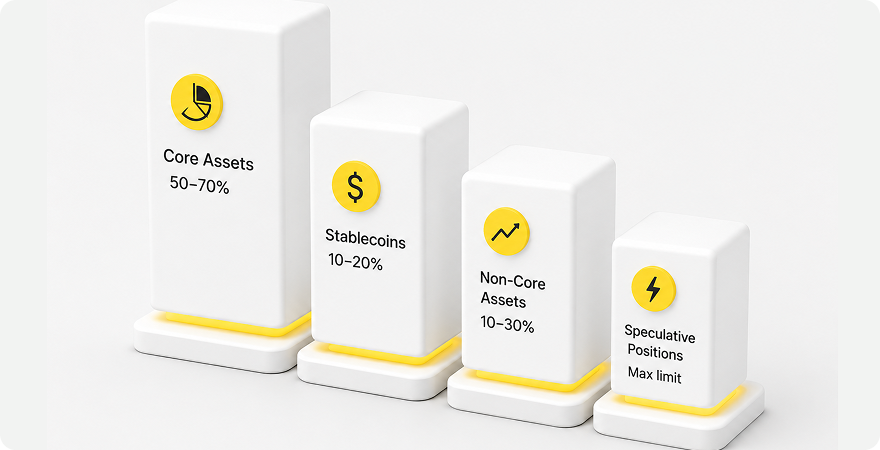
What’s the target allocation across categories? A reasonable starting structure for a beginner is something like: 50–70% in core assets (BTC and ETH), 10–20% in stablecoins as dry powder and yield generation, 10–30% in higher-conviction non-core assets, and a hard ceiling on speculative positions. The exact numbers matter less than the discipline of having them written down. The plan also specifies rebalancing rules: when do you rebalance back to target, and what triggers a structural change to the targets themselves.

Three: entry criteria

What has to be true for you to open a new position? This includes both the trade thesis and the market context. A thesis-only entry — “I think this protocol is undervalued” — is incomplete without context: at what price level, with what position size, with what time horizon. The criteria don’t have to be quantitative, but they have to be specific enough that you can tell after the fact whether they were met.

Four: exit criteria

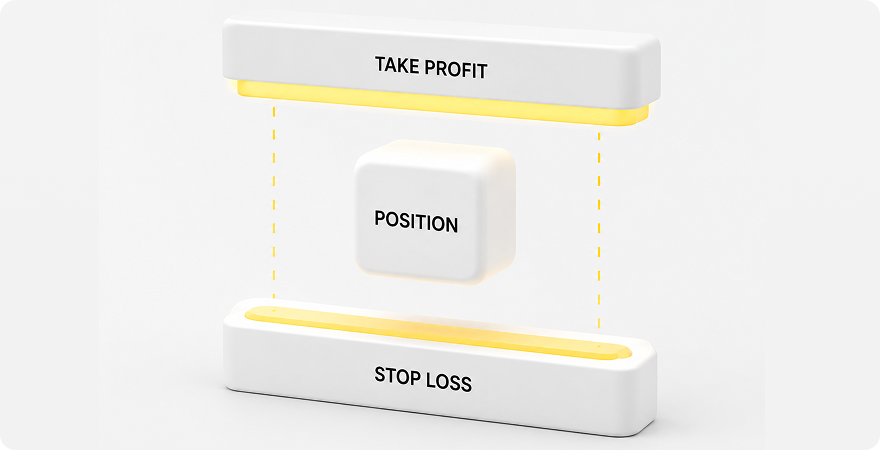
This is the section most traders skip and most regret skipping. Every position needs two pre-defined exits: the price at which the thesis has played out (take profit) and the price at which the thesis has been disproven (stop loss). Both numbers should be set before the position is opened and adjusted only based on new information, not based on emotional response to price movement. A useful rule: if you would not enter the position at the current price, you should be exiting it.

Five: risk management

Maximum position size per trade, maximum total exposure to a single sector or narrative, maximum acceptable drawdown before defensive action (reducing positions, moving to stablecoins, pausing new entries). The risk management section should make explicit what conditions would cause you to step back from the market entirely. New traders almost never set this in advance, which means by the time the conditions are met, they’ve already passed them.

Six: review cadence

When do you review the plan itself? Quarterly is reasonable for most non-professional traders. The review is not for tweaking based on recent performance — that’s curve-fitting — but for evaluating whether the plan still matches your objectives, your constraints, and your understanding of the market. A plan you wrote in a bull market and never revised is not the right plan for a bear market.

What a plan does not contain

Specific predictions about asset prices. Promises about returns. A long list of contingencies for every possible market state. The plan should be short enough that you can re-read it in five minutes. If it’s longer than two pages, it’s a research document, not a plan.

The traders who outperform are not the ones with the best analysis. They’re the ones who follow a mediocre plan consistently while everyone around them follows brilliant analyses inconsistently. 
The plan is the edge.


The 7 Most Common Mistakes New
Crypto Traders Make


The mistakes that destroy new crypto traders are not exotic. They’re predictable, they repeat across every market cycle, and they account for the overwhelming majority of avoidable losses. Recognizing them in advance is most of the protection.

One: position sizing that doesn’t survive a normal drawdown

New traders consistently size positions as if a 20% drawdown is unlikely. In crypto, a 20% drawdown is a routine occurrence on a multi-month horizon, and a 50% drawdown happens on roughly every major asset every few years. A position that’s comfortable at current prices but would be intolerable at half those prices is a position that’s too large. The right sizing question is not “what’s the expected return?” — it’s “would I be willing to hold this through a 50% drawdown without panicking?”

Two: no exit plan before entering

A trade is a complete idea only when the exit is defined. Both exits, actually: the price at which you take profit and the price at which you accept the thesis was wrong. New traders almost always have a clear entry thesis and almost never have a clear exit. The result is that decisions get made in the middle of volatility, which is the worst possible time to make them. The exit plan must be written down before the position is opened. Otherwise it doesn’t exist.

Three: using leverage early

Leverage in crypto is genuinely lethal to inexperienced traders. The combination of high underlying volatility and high leverage produces liquidations on relatively small adverse moves, and once you’ve been liquidated you no longer have a position to recover with when the market reverses. New traders are repeatedly drawn to leverage by the visible returns it produces in upside scenarios, while the much more frequent downside scenarios — liquidation, forced exit, account drained — are less visible because they don’t get screenshotted. Build your reflexes on spot. Leverage can wait.

Four: chasing pumps

A 30% rally over two days feels like an opportunity. It’s usually a distribution event. Buying after a sharp rally typically means buying from someone who’s been holding for months and is now selling into retail demand. New traders consistently buy late and sell early because the emotional signal — “everyone is excited about this” — is exactly inverted from the correct timing signal.

Five: confusing conviction with concentration

New traders who develop a strong thesis on a single asset often allocate disproportionately to it. Even when the thesis is correct, this is dangerous: a position large enough to be life-changing on the upside is large enough to be life-changing on the downside, and crypto regularly produces scenarios where a high-conviction position goes to zero (FTT, LUNA, dozens of others). A reasonable maximum on a single non-major asset is somewhere between 5% and 15% of the portfolio. Higher than that, the position is no longer a trade — it’s a bet on whether you’re right about the future.

Six: leaving large balances on exchanges

“Not your keys, not your coins” is a cliché because it’s true. Exchanges fail, freeze withdrawals, and occasionally lose customer funds. The lesson of the 2022 cycle was not that all exchanges are bad — it was that exchange custody is operationally convenient but structurally inferior to self-custody for any balance large enough to matter. The right pattern: keep working capital on the exchange, move long-term holdings to a hardware wallet you control.

Seven: trading on social media signals

Most influential crypto accounts are either openly long the assets they promote, paid to promote them, or both. The disclosure norms in crypto are weaker than in any other financial market, and the incentive structure of social media rewards confidence over accuracy. The traders who consistently make money are not the ones with the most followers. The right framework is to consume social media for narrative awareness — what’s being discussed — and to develop your own views on the underlying data rather than outsourcing them to anyone with a microphone.

None of these mistakes are about asset selection. All of them are about behaviour. Which means all of them are inside your control.


BTC vs ETH vs USDT: Which Should
You Start With?


The three largest crypto assets by market capitalisation — Bitcoin, Ethereum, and Tether — are often grouped together in beginner conversations as if they’re interchangeable. They’re not. Each was designed to do a fundamentally different thing, and the right starting point depends entirely on what you’re trying to accomplish.

Bitcoin (BTC): digital scarcity

Bitcoin was designed as digital money with a fixed supply cap of 21 million coins, no central issuer, and no possibility of monetary debasement. The thesis is straightforward: a scarce, censorship-resistant, globally accessible asset has value as a store of wealth, particularly in an environment of expanding fiat money supply. Bitcoin’s track record is the longest in the asset class — 16 years and counting. It’s the most liquid, the most institutionally adopted, and the most volatility-tested. It does one thing — store value — and it does that one thing better than any alternative.

What Bitcoin doesn’t do: smart contracts, decentralised applications, programmable money. The base layer is intentionally simple and deliberately slow to change. If you want functionality beyond holding and transferring value, Bitcoin is not the asset.

Ethereum (ETH): programmable money

Ethereum was designed as a general-purpose computing platform that happens to be denominated in cryptocurrency. The ETH token is partly a store of value, partly a payment for using the network (the gas that powers transactions), and partly a productive asset that can be staked to earn yield. The thesis is that a global, decentralised computer with no single point of failure has economic value, and that value accrues to ETH because ETH is the asset that powers it.

Ethereum’s risk profile is higher than Bitcoin’s. The protocol is more complex, the upgrade cadence is faster, and competing smart-contract platforms — Solana, Avalanche, others — are credible. The upside profile is also higher because the addressable market for “programmable money” is larger than the addressable market for “digital gold.”

Tether (USDT): dollar exposure on-chain

USDT is not an investment in the same sense as BTC or ETH. It’s a stablecoin pegged 1:1 to the US dollar, designed to hold its value rather than appreciate. The thesis for owning USDT is access, not return: you hold USDT to participate in crypto markets without taking price risk, to send dollar-equivalent value across borders without going through the banking system, or to earn yield through lending and DeFi protocols.

USDT’s risk is not market volatility. It’s issuer risk. Tether (the company) is supposed to hold dollar-denominated reserves backing every USDT in circulation. The composition of those reserves has been a recurring topic of discussion across the industry, and the regulatory framework is still maturing. USDC, issued by Circle, is structurally similar but operates under tighter US regulatory oversight; the trade-off is slightly less ubiquitous availability across smaller venues.

Which one should you start with?

Start with BTC if your primary thesis is wealth preservation, you have a multi-year time horizon, and you want the lowest-complexity, longest-track-record exposure in the asset class. This describes most beginners accurately, even if it doesn’t feel exciting.

Start with ETH if you want exposure to the broader trajectory of crypto beyond store-of-value, you’re comfortable with higher volatility and more protocol risk, and you intend to engage actively with the on-chain ecosystem (staking, DeFi, NFTs) rather than just holding.

Start with USDT or USDC if you don’t yet have a directional view, you want to onboard capital into the crypto ecosystem without taking immediate price risk, or you’re using crypto rails for payment and transfer purposes rather than as an investment.

The most common mistake beginners make is choosing based on which asset has the most narrative momentum at the moment of decision. The right framework is choosing based on what you’re actually trying to do.


The Essential Crypto Glossary: 40 Terms Every Trader Should Know


Most crypto glossaries are either too shallow to be useful or too technical to be readable. This one targets the middle: forty terms that come up regularly in crypto trading and that, once understood, unlock most of the rest of the vocabulary.

Market structure terms

Liquidity. The depth of buy and sell orders on an exchange. High liquidity means large orders can be filled without significantly moving the price.

Spread. The difference between the highest bid and the lowest ask. Wider spreads mean higher round-trip trading costs.

Slippage. The difference between the expected price of a trade and the actual fill price, caused by trading through multiple price levels in the order book.

Order book. The list of open buy and sell orders on an exchange, ranked by price.

Market order. An order to buy or sell immediately at the best available price.

Limit order. An order to buy or sell at a specified price or better.

Stop-loss order. A conditional order that becomes a market order when a specific price level is reached, used to limit losses.

OTC. Over-the-counter; trades negotiated directly between two parties rather than executed on a public order book.

Asset and protocol terms

Bitcoin (BTC). The first and largest cryptocurrency by market capitalisation, designed as a peer-to-peer electronic cash system.
 
Ethereum (ETH). The second-largest cryptocurrency, designed as a programmable blockchain that supports smart contracts.
 
Stablecoin. A cryptocurrency designed to maintain a fixed value, usually pegged to a fiat currency like the US dollar.

USDT, USDC. The two largest stablecoins by market capitalisation, both pegged to the US dollar.
 
Altcoin. Any cryptocurrency other than Bitcoin.
 
Token. A cryptocurrency that runs on top of another blockchain, as opposed to a coin that has its own native blockchain.
 
Smart contract. Self-executing code deployed on a blockchain, enabling programmable transactions.
 
Gas. The fee paid to network validators for processing transactions on a blockchain like Ethereum.

Custody and security terms

Wallet. Software or hardware that stores the private keys needed to access cryptocurrency.
 
Private key. The cryptographic key that authorises spending from a wallet. Whoever controls the private key controls the funds.
 
Seed phrase. A human-readable backup of a wallet’s private keys, typically twelve or twenty-four words.
 
Hot wallet. A wallet connected to the internet, convenient but more vulnerable to compromise.
 
Cold wallet. A wallet stored offline, typically on a hardware device, much less vulnerable to remote attack.
 
Self-custody. Holding cryptocurrency in a wallet whose private keys you control, as opposed to leaving funds on an exchange.
 
KYC. Know Your Customer; the identity verification process required by regulated exchanges.
 
AML. Anti-Money Laundering; the regulatory framework that governs financial institutions, including crypto exchanges.

Trading and derivatives terms

Spot. The market for immediate delivery of an asset, as opposed to derivatives.
 
Futures. A contract to buy or sell an asset at a specified future date and price.
 
Perpetual contract. A futures contract with no expiry date, used widely in crypto for leveraged trading.
 
Funding rate. The periodic payment between long and short holders of a perpetual contract, designed to keep its price close to spot.

Open interest. The total number of open derivative contracts on a particular asset.
 
Liquidation. The forced closure of a leveraged position when its margin falls below the maintenance requirement.
 
Leverage. Borrowed capital used to amplify exposure to an asset. Multiplies both gains and losses.
 
Long. A position that profits if the asset’s price rises.
 
Short. A position that profits if the asset’s price falls.

Market behaviour terms

Bull market. A sustained period of rising prices.
 
Bear market. A sustained period of falling prices.
 
Drawdown. The decline from a peak to a subsequent trough, typically expressed as a percentage.
 
Volatility. The magnitude of price fluctuations over a given period.
 
Halving. The Bitcoin protocol’s scheduled reduction of new coin issuance, occurring roughly every four years.
 
Whale. A holder with a position large enough to influence the market through their trading activity.
 
HODL. Long-term holding of an asset through volatility, originally a typo of “hold” that became a community term.
 
DYOR. “Do your own research”; the standard disclaimer attached to crypto commentary.
 
This vocabulary covers the substantive surface area of crypto trading conversation. Once these terms are familiar, the next tier — specific protocols, narratives, and technical concepts — becomes much easier to absorb.

Cookies preferences

Others

Other uncategorized cookies are those that are being analyzed and have not been classified into a category as yet.

Necessary

Necessary
Necessary cookies are absolutely essential for the website to function properly. These cookies ensure basic functionalities and security features of the website, anonymously.

Advertisement

Advertisement cookies are used to provide visitors with relevant ads and marketing campaigns. These cookies track visitors across websites and collect information to provide customized ads.

Analytics

Analytical cookies are used to understand how visitors interact with the website. These cookies help provide information on metrics the number of visitors, bounce rate, traffic source, etc.

Functional

Functional cookies help to perform certain functionalities like sharing the content of the website on social media platforms, collect feedbacks, and other third-party features.

Performance

Performance cookies are used to understand and analyze the key performance indexes of the website which helps in delivering a better user experience for the visitors.