


How to Build Your First Crypto Portfolio (A Framework)
August 6, 2026
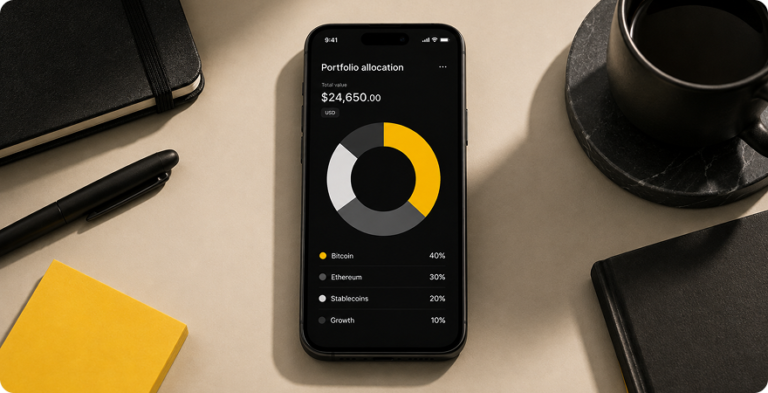
Most beginner crypto portfolios are not built. They accumulate. A position here because of an article. A position there because of a friend’s recommendation. A few tokens picked up during a frenzy and forgotten. After two years, the resulting portfolio is a museum of past decisions, with no coherent thesis tying the holdings together. This is the default and it produces predictable underperformance.
A built portfolio looks different. It starts from a target allocation, uses each asset to fill a specific role, and gets rebalanced on a schedule rather than on emotion.
The five-bucket framework
Core allocation (50–70%). Bitcoin and Ethereum, in some ratio. These are the assets with the longest track records, the deepest liquidity, the most institutional adoption, and the lowest probability of going to zero. A reasonable starting split is 60/40 BTC/ETH or 70/30, depending on whether your conviction skews more towards the store-of-value thesis (favours BTC) or the programmable-money thesis (favours ETH). The core allocation is the part of the portfolio that’s not supposed to be exciting. It’s the foundation that the rest of the portfolio sits on.
Stablecoin reserve (10–20%). USDC, USDT, or a mix. This bucket serves three purposes: dry powder for buying during drawdowns, yield generation through lending or DeFi, and a defensive layer that doesn’t get destroyed during sharp market declines. Many beginners under-allocate to stablecoins because they feel like sitting in cash during a market they’re trying to participate in. The right framing: the stablecoin allocation is what allows you to be aggressive in the rest of the portfolio when others can’t.
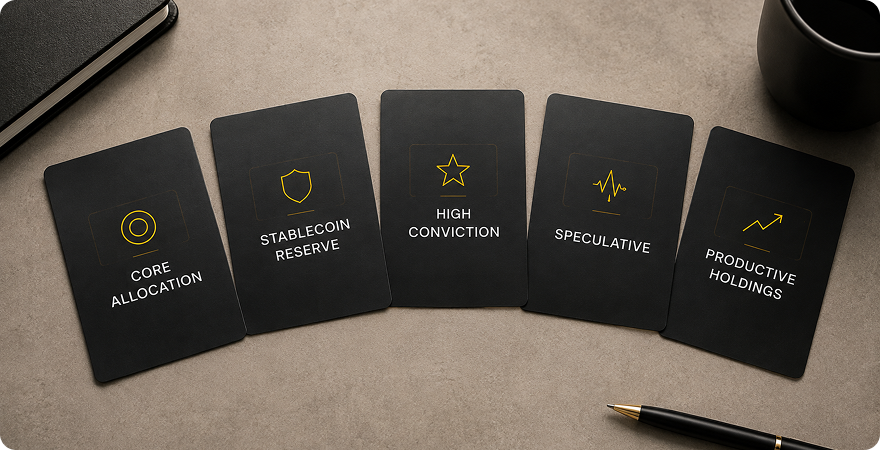
High-conviction non-core (10–25%). Two to five assets you’ve researched and have a specific thesis on. This might be a Layer 1 platform you believe in, a DeFi protocol with genuine revenue, a infrastructure token with real adoption. Each position in this bucket should have a written thesis, a sizing decision, and pre-defined exits. Limit position sizes within this bucket so that no single asset exceeds 10% of the total portfolio.
Speculative (0–10%). Smaller-cap tokens, narrative trades, early-stage positions. The bucket where you take asymmetric upside bets with capital you can fully lose. Discipline here matters more than anywhere else: the bucket should be sized so that going to zero is annoying but not catastrophic, and individual positions should never exceed 2–3% of the total portfolio. This is also the bucket where most beginners over-allocate, treating speculative trades as the main event rather than the satellite.
Productive holdings (0–15%). Assets being put to work — staked ETH earning protocol rewards, BTC earning yield through reputable lending platforms, stablecoins in DeFi lending markets. This isn’t a separate asset bucket so much as an active state for assets in the other buckets. The yield is meaningful at the portfolio level (3–7% on stablecoins, 3–4% on staked ETH) but introduces smart-contract and counterparty risk that has to be sized accordingly.
Rebalancing rules
A portfolio without rebalancing rules drifts: the winners grow as a share of the total, the losers shrink, and the original target allocation becomes a memory. Two approaches work for beginners.

Calendar rebalancing. Once a quarter, sell some of what’s grown beyond target and buy what’s fallen below. This is simple, predictable, and tax-aware (you can choose timing for tax optimisation). The downside is that you rebalance whether the market wants it or not.
Threshold rebalancing. Rebalance when any single allocation drifts more than 5 percentage points from its target. This is more market-responsive but requires more attention. Most beginners are better served by calendar rebalancing.
What to avoid
Diversifying into 30+ assets. Beyond about 10–15 holdings, additional positions don’t add diversification — they just add complexity. A focused portfolio you understand outperforms a diversified portfolio you don’t.
Position sizing by enthusiasm. The position size of any asset should be determined by the framework, not by how excited you are about it. The most overweighted positions in retail portfolios are consistently the ones that underperform most.
Treating the portfolio as static. Markets change, theses get proven wrong, new opportunities appear. The portfolio framework is a starting point that should evolve based on new information, but it should evolve deliberately — not reactively to the last thing you read.
A portfolio built on purpose, even an imperfect one, beats a portfolio that just happened. The discipline of structure compounds.
Continue with UAB Exchange
Subscribe to our weekly market brief for structural analysis of crypto market dynamics, on-chain flows, and the macro context shaping digital-asset prices.
Subscribe