

The 7 Most Common Mistakes New Crypto Traders Make
July 23, 2026

The mistakes that destroy new crypto traders are not exotic. They’re predictable, they repeat across every market cycle, and they account for the overwhelming majority of avoidable losses. Recognizing them in advance is most of the protection.
One: position sizing that doesn’t survive a normal drawdown
New traders consistently size positions as if a 20% drawdown is unlikely. In crypto, a 20% drawdown is a routine occurrence on a multi-month horizon, and a 50% drawdown happens on roughly every major asset every few years. A position that’s comfortable at current prices but would be intolerable at half those prices is a position that’s too large. The right sizing question is not “what’s the expected return?” — it’s “would I be willing to hold this through a 50% drawdown without panicking?”
Two: no exit plan before entering
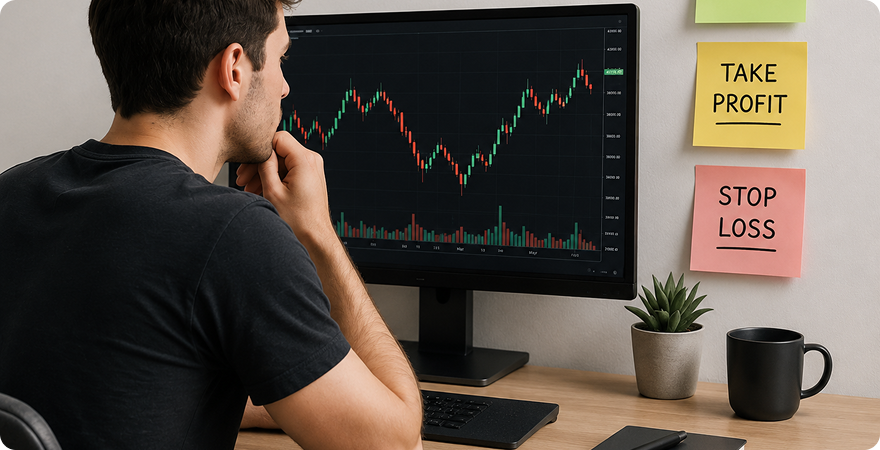
A trade is a complete idea only when the exit is defined. Both exits, actually: the price at which you take profit and the price at which you accept the thesis was wrong. New traders almost always have a clear entry thesis and almost never have a clear exit. The result is that decisions get made in the middle of volatility, which is the worst possible time to make them. The exit plan must be written down before the position is opened. Otherwise it doesn’t exist.
Three: using leverage early
Leverage in crypto is genuinely lethal to inexperienced traders. The combination of high underlying volatility and high leverage produces liquidations on relatively small adverse moves, and once you’ve been liquidated you no longer have a position to recover with when the market reverses. New traders are repeatedly drawn to leverage by the visible returns it produces in upside scenarios, while the much more frequent downside scenarios — liquidation, forced exit, account drained — are less visible because they don’t get screenshotted. Build your reflexes on spot. Leverage can wait.
Four: chasing pumps
A 30% rally over two days feels like an opportunity. It’s usually a distribution event. Buying after a sharp rally typically means buying from someone who’s been holding for months and is now selling into retail demand. New traders consistently buy late and sell early because the emotional signal — “everyone is excited about this” — is exactly inverted from the correct timing signal.
Five: confusing conviction with concentration
New traders who develop a strong thesis on a single asset often allocate disproportionately to it. Even when the thesis is correct, this is dangerous: a position large enough to be life-changing on the upside is large enough to be life-changing on the downside, and crypto regularly produces scenarios where a high-conviction position goes to zero (FTT, LUNA, dozens of others). A reasonable maximum on a single non-major asset is somewhere between 5% and 15% of the portfolio. Higher than that, the position is no longer a trade — it’s a bet on whether you’re right about the future.

Six: leaving large balances on exchanges
“Not your keys, not your coins” is a cliché because it’s true. Exchanges fail, freeze withdrawals, and occasionally lose customer funds. The lesson of the 2022 cycle was not that all exchanges are bad — it was that exchange custody is operationally convenient but structurally inferior to self-custody for any balance large enough to matter. The right pattern: keep working capital on the exchange, move long-term holdings to a hardware wallet you control.
Seven: trading on social media signals
Most influential crypto accounts are either openly long the assets they promote, paid to promote them, or both. The disclosure norms in crypto are weaker than in any other financial market, and the incentive structure of social media rewards confidence over accuracy. The traders who consistently make money are not the ones with the most followers. The right framework is to consume social media for narrative awareness — what’s being discussed — and to develop your own views on the underlying data rather than outsourcing them to anyone with a microphone.
None of these mistakes are about asset selection. All of them are about behaviour. Which means all of them are inside your control.

Continue with UAB Exchange
Subscribe to our weekly market brief for structural analysis of crypto market dynamics, on-chain flows, and the macro context shaping digital-asset prices.
Subscribe