

Timing the Crypto Market: Why DCA Usually Beats Lump-Sum (And When It Doesn’t)
July 21, 2026
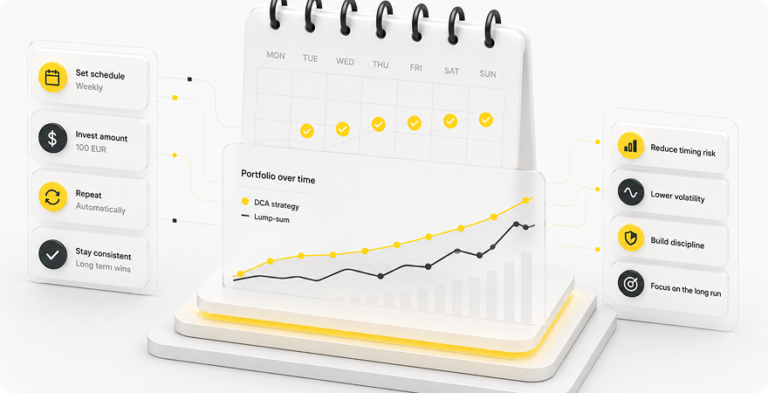
Dollar-cost averaging is the strategy nobody finds exciting and almost everyone should be using. The reason is not that DCA produces the highest possible return — it doesn’t — but that it produces near-optimal returns for the actual human behaviour of the people executing it. The strategy that you can stick to through a fifty percent drawdown is worth more than the strategy that mathematically dominates in a spreadsheet but breaks down in your head at the moment of stress.
What DCA actually does
Dollar-cost averaging buys a fixed dollar amount of an asset on a fixed schedule, regardless of price. The mechanical effect is that you buy more units when the price is low and fewer units when the price is high, which produces an average entry price below the simple time average of the asset’s price over the period. The psychological effect, which matters more, is that the schedule replaces decision-making. You don’t have to time the entry, which means you can’t time it badly.
The case for DCA in crypto specifically
Crypto’s volatility makes timing both more tempting and more punishing. The asset class regularly produces 50% drawdowns and 200% rallies in compressed timeframes. The trader who tries to time entries is making high-stakes decisions in an environment specifically designed to defeat human pattern-matching. Studies of retail trading data — across both crypto and traditional markets — consistently show that retail traders underperform a simple buy-and-hold benchmark by a meaningful margin, and the underperformance is almost entirely attributable to bad timing rather than bad asset selection.
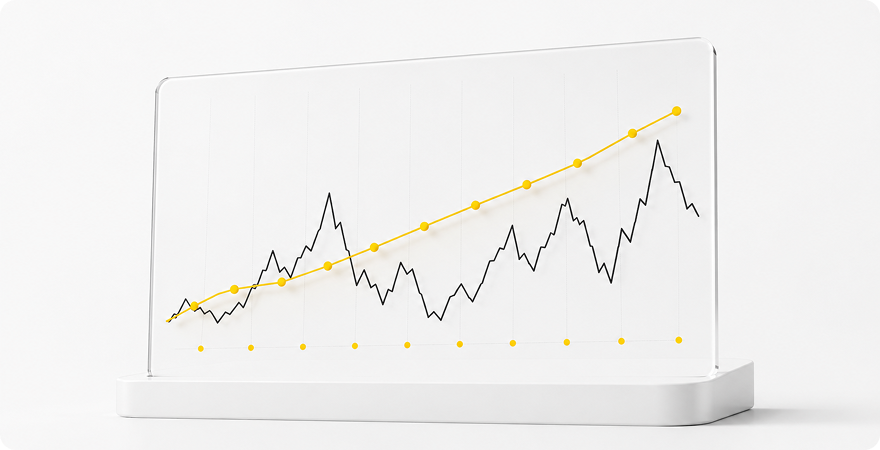
DCA removes timing as a source of error. Over a multi-year horizon in crypto, a weekly or monthly DCA into Bitcoin has historically outperformed approximately 90% of attempts at active timing by the same investor over the same period.
Where DCA underperforms
In persistently rising markets, lump-sum investment outperforms DCA by definition. If you have $12,000 to deploy and the asset rises monotonically over the next twelve months, deploying all of it on day one produces a higher return than spreading it across twelve monthly purchases. This is the case academics use to argue against DCA, and it’s mathematically correct. The problem is that you don’t know in advance whether the next twelve months will be a persistent uptrend or a 60% drawdown followed by a recovery. DCA loses a small amount of return in the first scenario and saves a large amount in the second, which is a favourable expected-value trade for most investors.
A reasonable DCA approach for crypto
Pick a fixed amount that’s small enough to be sustainable for at least twelve months and that doesn’t disrupt your other financial obligations.
Choose a frequency — weekly or monthly are both fine. Automate the recurring purchase via the exchange’s scheduled buy feature. Don’t change the schedule based on price action. The point is to remove the decision, not to add a new one.
When to break the pattern
Two cases. Tax-loss harvesting at year-end, where a tactical adjustment can reduce tax liability without changing the underlying thesis. And generational drawdowns — Bitcoin at $15,000 in late 2022, for example — where the asset is trading at a structurally low price relative to its long-term trajectory. Outside those cases, the discipline is the strategy.

The most successful crypto investors over five-year horizons are not the ones with the cleverest entries. They’re the ones who kept buying through the cycles when everyone else stopped.
Continue with UAB Exchange
Subscribe to our weekly market brief for structural analysis of crypto market dynamics, on-chain flows, and the macro context shaping digital-asset prices.
Subscribe