

How to Read Crypto Market Signals Before You Trade
July 6, 2026

The crypto information environment is loud. Telegram channels, X accounts, YouTube influencers, and trading newsletters produce enough content per hour to occupy a full-time attention budget, and most of it is noise. Cutting through to the signal that actually matters is less about consuming more and more about consuming better.
Five categories of data tend to lead price action. Everything else lags.
You can use e-Pocket to send money to Panama today. To learn more about the countries on our extensive platform, read our blog page.
On-chain flows
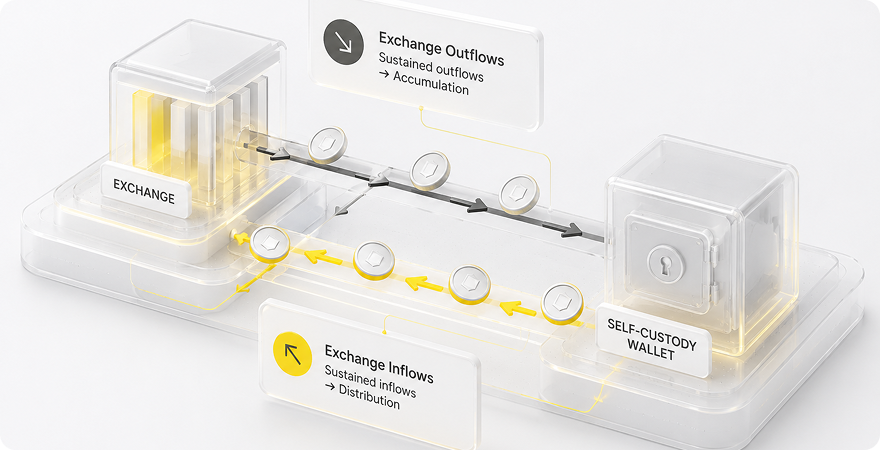
The movement of coins between exchanges and self-custody wallets is one of the few genuinely leading indicators in crypto. Sustained exchange outflows historically precede accumulation phases; sustained exchange inflows tend to precede distribution. The data is public and free — Glassnode, CryptoQuant, and Nansen publish dashboards — and most traders ignore it because it doesn’t produce a clean buy or sell signal. It produces a directional bias.
Stablecoin supply changes
Large mints of USDT or USDC are capital entering the crypto ecosystem; large burns are capital exiting. Net stablecoin supply growth over a one to two week window correlates strongly with subsequent market direction. This is not a precise timing tool, but it tells you which side of the trade has the wind behind it.
Funding rates and open interest
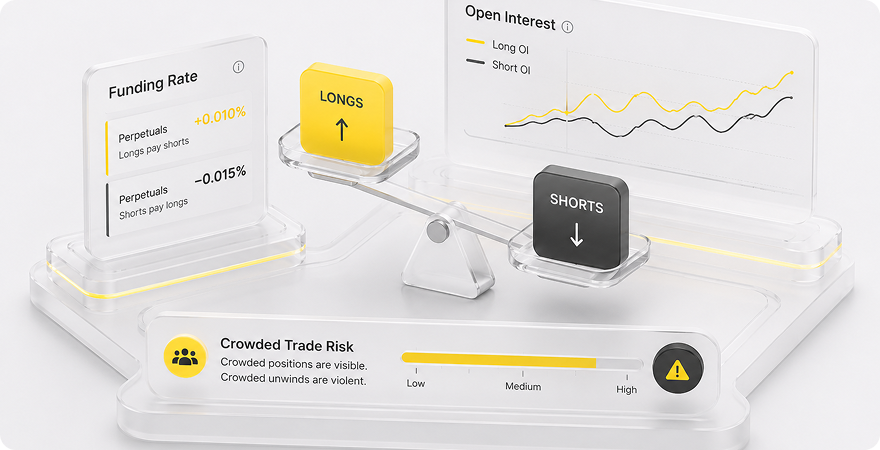
The derivatives market is several times larger than spot, which means derivatives positioning often determines short-term price action. Funding rates show whether longs or shorts are paying the premium; persistently positive funding signals an overcrowded long, persistently negative signals an overcrowded short. Combined with open interest trends, this gives a read on where the crowded trade is — and crowded trades unwind violently.
Macroeconomic context
Bitcoin in particular trades increasingly as a macro asset. US dollar strength (DXY), real yields, and central bank policy direction all matter. A trader who ignores macro because “crypto is independent” is operating on a thesis that has been wrong for most of the last four years. The relationship is not always linear, but it’s persistent.
Narrative momentum
This is the soft signal that’s hardest to measure and most often dismissed by analytical traders, which is exactly why it works. Sector rotation in crypto — AI tokens, real-world assets, Layer 2s, DePIN, memecoins — is driven by narrative more than by fundamentals. The trader who reads narrative early and exits when it goes mainstream consistently outperforms the trader who waits for confirmation.
What to ignore
Most chart pattern analysis below the four-hour timeframe is essentially noise. Most “whale alert” social posts are either too late to act on or are themselves a coordination signal rather than a genuine flow indicator. Most price predictions from anyone who isn’t disclosing their position are entertainment, not analysis.
A reasonable weekly routine
Twenty minutes on Monday morning checking on-chain dashboards. Five minutes daily checking funding rates and open interest. A weekly read on macro positioning. And a rolling list of three to five active narratives to track. That’s the entire input set for most traders below institutional size. Anything beyond it produces marginal information at increasing time cost.
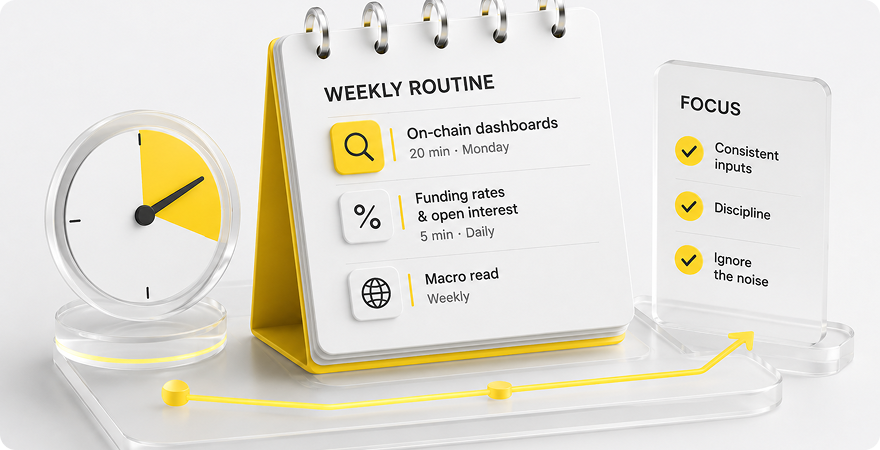
The traders who consistently outperform are not the ones consuming the most market commentary. They’re the ones who’ve narrowed their inputs to the few categories that actually lead, and disciplined themselves to ignore everything else.
Continue with UAB Exchange
Subscribe to our weekly market brief for structural analysis of crypto market dynamics, on-chain flows, and the macro context shaping digital-asset prices.
Subscribe